A Chapter of HFR’s Buyer’s Guide to High-End Audio
McIntosh Laboratory is the oldest continuously operating high-end audio company in the United States, and one of the very few whose founding stretches back to 1949 — the origin of hi-fi itself. For 76 years, McIntosh has designed and built amplifiers, preamplifiers, and audio electronics in Binghamton, New York, where every unit is still hand-assembled at the same factory site the company has occupied since 1956.
This Buyer’s Guide is Chapter 6 of the HiFi Registry series on the brands that define high-end audio. It exists because McIntosh is unusual in the used market: 76 years of continuous production means every generation of McIntosh product still has a service pathway through a distinctive ecosystem of factory service, Authorized Service Agencies, and independent authorized specialists — but the factory warranty is expressly non-transferable, and McIntosh maintains an explicit unauthorized-reseller list that voids warranty regardless of unit age. Understanding these dynamics matters more for a used McIntosh buyer than for buyers of most other high-end brands.
17 active listings on HFR. Sold prices between $7,500 and $7,500 over the last 90 days.
The Brand
McIntosh Laboratory is one of the very few high-end audio companies whose founding stretches back to the origin of hi-fi itself. Co-founded in 1949 by Frank H. McIntosh and Gordon Gow, the company has spent 76 years continuously building amplifiers and audio electronics — first in Silver Spring, Maryland, and since April 1951 in Binghamton, New York, where the current factory at 2 Chambers Street has been the company’s home since the building was completed in 1956.
Because McIntosh makes a broader range of products than most high-end brands — spanning integrated amps, tube power amps, solid-state power amps, preamps, digital sources, turntables, speakers, and home theater processors — the natural way to walk the current lineup is by product category. Start with the category you need, then match to the tier that fits.
Integrated Amplifiers (MA series)
McIntosh integrated amplifiers combine preamplifier and power amplifier in a single chassis, typically with the DA2 digital audio module for streaming and digital sources. Current lineup from entry through flagship:
Separately, McIntosh offers hybrid entry integrateds (MA252, MA352 — solid-state amp with tube preamp in open-chassis MC275-inspired styling) and the MSA5500 streaming integrated with built-in DAC, Wi-Fi, Bluetooth, and MM phono.
Tube Power Amplifiers (the MC275 family)
Six current tube power amps, all using the patented Unity Coupled Circuit output transformer:
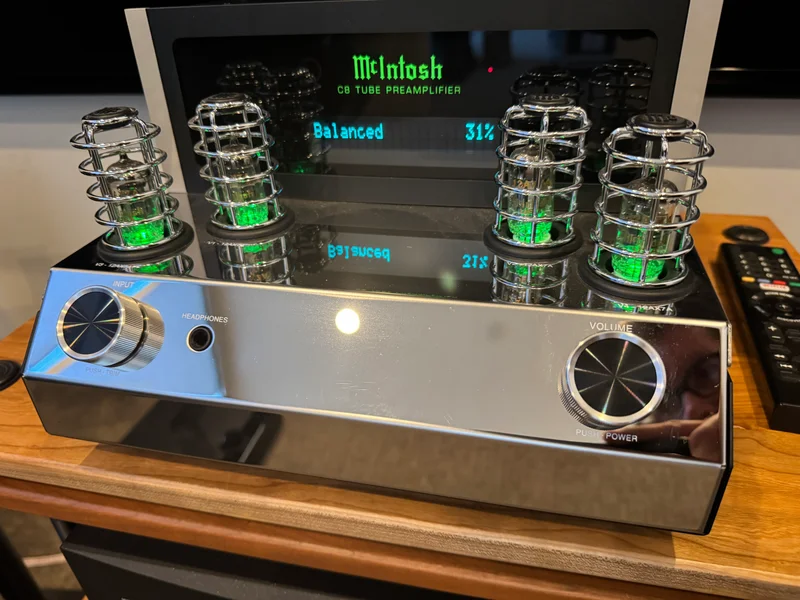
McIntosh preamplifiers split into solid-state, tube, and hybrid designs:
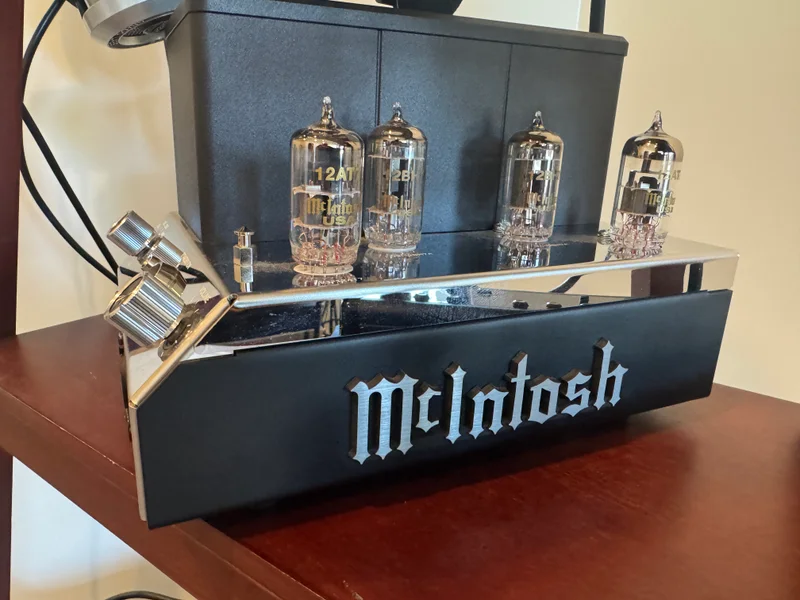
C8 — Entry tube preamp with open-chassis industrial design similar to the MC275; pairs with the matching MC830 amplifier for a complete open-chassis system
Current digital lineup includes CD/SACD transports and integrated players (MCD85, MCT500, MCD350, MCD600, MCD12000), standalone DAC modules (the DA2 module built into integrateds and preamps; MDA200 standalone), and media streamers (MB25, DS200, MS500). The DA2 Digital Audio Module offers Quad Balanced 8-channel 32-bit DAC with DSD playback via USB, HDMI ARC for TV integration, and multiple digital inputs. The MCT (McIntosh Cable Transport) input provides secure DSD connection to McIntosh SACD transports.
Turntables
Current lineup: MT2, MT5, MT10, MTI100 (turntable + integrated amp). The MT10 Precision Turntable was McIntosh’s return to vinyl in 2008.
Speakers
Current speaker lineup includes XR50, XR100, XRT1.1K, XRT2.1K towers; ML1 MK II standmount; LCR80 center channel; XCS1.5K center channel array; and PS1K/PS2K powered subwoofers. McIntosh returned to speaker manufacturing after acquiring the ability to properly complement its own electronics.
Home Theater / Multi-channel
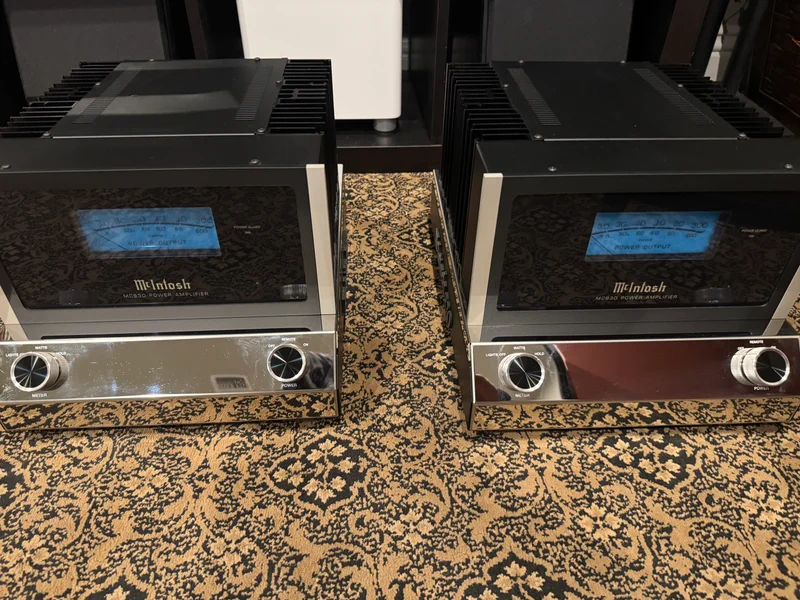
Home theater processors (MX200, MX123) and multi-channel amplifiers (MC257, MC303, MC8207, MC255, MI128, MI254, MI347, MI502, MC830). The MC8207 is McIntosh’s most popular multi-channel amp.
Headphone Amplifiers, FM Tuners, and Receivers
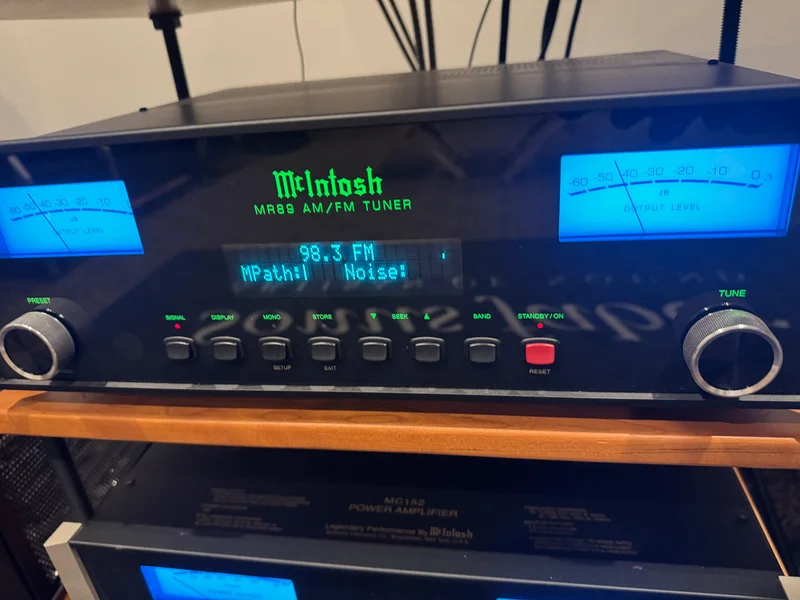
MHA50 and MHA200 headphone amps (the MHA200 is a scaled MC275-style tube design). MR89 FM tuner (McIntosh has continuously made FM tuners since the MR55 in 1957). Stereo receivers MAC7200 and MHT300. Integrated Audio System RS150.
The Three-Layer Service Ecosystem
McIntosh occupies a unique position in high-end audio: 76 years of continuous production means that every generation of McIntosh product — from 1949 through today — potentially still has a service pathway. Understanding how that ecosystem works matters more for a used McIntosh buyer than any single specification.
Standard warranty structure
McIntosh’s factory warranty is straightforward and consistent across the lineup:
Two limitations directly shape the used-market decision:
First,McIntosh warranty is expressly non-transferable to subsequent owners. The warranty policy is explicit that if the original owner transfers ownership of the product prior to expiration of the three-year term, the warranty terminates in its entirety upon the date of transfer. This is meaningfully more restrictive than Wilson Audio’s transferable warranty or dCS’s transferable-once policy. Used McIntosh buyers inherit no factory warranty even on relatively new units.
Layer 2: Authorized Service Agency network.McIntosh maintains a searchable directory of regional Authorized Service Agencies that owners can use to find approved service outside of shipping a unit back to the factory directly. This is a materially different structure from most high-end audio brands, where all service typically funnels through the factory alone.
Layer 3: Independent authorized specialists — the vintage service ecosystem. Because of McIntosh’s 76 years of continuous production, an ecosystem of independent specialists has grown up around Binghamton and elsewhere to service vintage and out-of-current-production units:
Audio Classics — located near the McIntosh factory in Binghamton, specializes in vintage McIntosh sales and service; sells used and discontinued McIntosh gear
Bob the Tech Audio — founded 2020, has repaired or restored numerous McIntosh components; several findings have made it from the bench back to McIntosh Labs
Absolute Sound Laboratories — offers a formal distinction between “Repair” (address specific failures) and “Restoration” (full component-level restoration including electrolytic capacitors, coupling capacitors, and updated semiconductors)
The independent specialist ecosystem is distinctive to McIntosh. Other high-end audio brands typically depend on factory-only or single-authorized-partner service. McIntosh’s 76-year continuous production has created enough demand for vintage restoration expertise that specialized independent shops have become an essential part of how the brand actually works in the real world.
First, the non-transferable warranty means “used McIntosh” typically means “no factory warranty” — even for units under three years old. Dealer-consigned McIntosh (particularly through Reference Platinum or Platinum dealers) may include dealer-provided limited warranty terms; private-party units typically do not.
Second, the authorized service ecosystem — factory service + Authorized Service Agencies + Audio Classics / Bob the Tech / Absolute Sound Labs — means a used McIntosh purchase does not orphan the owner from serviceability. The pathway back to factory-original condition or full restoration exists for essentially the entire history of the brand.
Third, the unauthorized-reseller list from McIntosh is worth checking before buying used. Products originally purchased through unauthorized channels have no factory warranty regardless of current owner.
Fourth, age matters less for McIntosh than for most brands. A well-maintained MC275 from the 1990s reintroduction era can be sonically indistinguishable from a Mk VI current-production unit after basic capacitor service.
Setup and Installation
McIntosh setup considerations vary significantly across the range. The essentials that apply broadly:
Weight and physical size
McIntosh amplifiers scale from moderately-sized integrateds up to enormous flagship monoblocks. The MC1.25KW weighs 158 pounds per unit; the MC2KW is a three-module design where each module weighs 90+ lbs. Setup for flagship-tier McIntosh electronics requires a rack that can support the weight and, for the monoblocks, planning for placement near the speakers rather than in a central rack. Two-person minimum for anything at MC462-and-above level.
Tube amp break-in and hours
Tube amps (MC275, MC1502, MC2152, MC3500 Mk II, MC901’s tube section) benefit from break-in over the first 50-100 hours. Tubes themselves have a service life — the KT88 output tubes used in MC275 and MC1502 typically last thousands of hours of use, while the small signal tubes typically last longer. For a used tube amp purchase, ask the seller about tube hours if known, and budget for a fresh tube set on a unit with unknown or extensive use.
Autoformer / Unity Coupled Circuit and speaker matching
McIntosh electronics run warmer than average due to their high-power output stages. Standard rack ventilation is sufficient for MA5300 and MA7200 tier; MA9500, MC462, and above benefit from additional ventilation space above and behind the unit. Tube amps need substantially more clearance — MC275, MC1502, MC2152 all vent heat through the top of the chassis where the tubes are exposed.
Blue meter functionality
The signature blue watt meters are functional as well as aesthetic. Reading them accurately in the first few weeks of ownership teaches the owner how much power their system actually uses at their listening volume — the large, blue watt meter provides a swift and accurate reading of the amplified signal. Users can disable the meter illumination via front-panel controls on most models.
Remote control and Roon integration
Current-generation McIntosh integrateds (MA8950, MA9500, MA12000) and preamps (C55, C2800, C12000) include Power Control connections for coordinated system on/off, IR remote controls, and Roon Ready or Roon Tested certification. Older units without Roon integration can typically be integrated into a Roon system through a Roon-Ready streamer feeding the McIntosh preamp/integrated as a fixed-level input.
What to Look for Buying Used
Buying a used McIntosh component is different from buying a used unit of most high-end brands. Glass panel condition, blue meter functionality, DA1-vs-DA2 module distinction, tube hours, warranty transferability, and original authorized-dealer origin all matter to the buy/pass decision.
Cosmetic condition of glass panels and blue meters
The signature glass front panels with silk-screened lettering and the blue backlit meters are what visually make a McIntosh a McIntosh. Inspect under bright directional light: any chips or cracks in the glass, faded silk-screening, dim or non-functional meter LEDs. Glass panel damage is repairable only through factory-coordinated service and is expensive; meter LED failures on older units may indicate impending broader electronics issues. For any Mac being considered above the MA5300 tier, insist on clear photographs of the glass under bright light.
Blue meter LED status check
All meter LEDs should function correctly and consistently. On tube amps, the small-tube LEDs sequence through amber-to-green during power-up per McIntosh’s spec — a small tube glowing red during operation indicates an output tube failure. Ask the seller to power up the unit on video before purchase and confirm proper LED sequencing.
Tube condition and hours (for tube amps)
For MC275, MC1502, MC2152, MC3500 Mk II, and MC901 tube section: ask about tube brand, generation, and estimated hours. KT88 output tubes have finite life; even name-brand replacements are a meaningful expense. On a used MC275, a fresh set of matched KT88s is a real investment beyond the purchase price. Budget for it.
DA1 vs DA2 digital module distinction
Critical for used integrateds: the MA8900 and MA9000 shipped with the earlier DA1 Digital Audio Module; the MA8950 and MA9500 (both launched Feb 2022) ship with the improved DA2 Digital Audio Module with Quad Balanced 8-channel 32-bit DAC, DSD playback support via USB, and HDMI ARC for TV integration. A used MA9000 costs meaningfully less than a used MA9500 largely because of this module difference. The DA1 module can be upgraded to DA2 at a McIntosh authorized service center.
Original packaging
For large amps (MC462 and above), original packaging is critical for safe transit. McIntosh’s flagship monoblocks (MC1.25KW at 158 lbs, MC2KW as three modules) require specialized packing crates that are difficult or impossible to replace. A used flagship-tier unit without original packaging is meaningfully worth less because future factory service requires safe transit.
For McIntosh speaker purchases: inspect cabinet finish, driver surrounds, and grille cloth. McIntosh speakers use conventional cabinet construction more comparable to competing high-end speaker brands than to Sonus faber-style hand-worked cabinets, but flagship models like XRT1.1K and XRT2.1K towers are large multi-driver arrays where original driver condition matters.
Used Market Overview
The used market for McIntosh has five patterns worth understanding before you shop.
MC275 holds value indefinitely
The MC275 is essentially a classic. Its continuous production since 1993 (and originally 1961-1971) means any well-maintained unit has value; well-cared-for early Commemorative Edition units from the 1990s continue to trade near their original price. This is unusual in the audio market and reflects the MC275’s iconic status.
Tube amps generally depreciate slower than solid-state
McIntosh tube amps (MC275, MC1502, MC2152, MC3500 Mk II, MC901, MC2301) tend to hold value better than solid-state peers because the sound signature is distinctive and the design language (visible tubes, glass panels, blue meters) is genuinely iconic.
DA1 vs DA2 pricing gap on integrateds
The 2022 MA8950/MA9500 refresh introduced a specific used-market dynamic. DA1-equipped units (MA8900, MA9000) trade at meaningful discount versus DA2-equipped units (MA8950, MA9500) reflecting the digital module improvement. A used MA9000 with the DA1 module plus budget for the DA2 upgrade is often a smarter used purchase than paying MA9500 pricing outright.
Flagship monoblocks trade slowly
MC1.25KW and MC2KW have smaller resale markets given their price and physical demands. Expect longer time-to-sale on these units, but also stronger negotiating leverage as a buyer given the small pool of interested buyers.
Historical/collectible models
The MC30, MC60 (both 1954), MC240, MC275 original (1961-1971), MC2300 (1974 Wall of Sound era), and MC3500 (1969 Woodstock era) are collectible items with active secondary markets. Prices reflect condition and completeness rather than pure sonic performance. If you’re considering a historical model, expect prices well above equivalent-tier current production reflecting collectibility.
HFR Value Retention story for McIntosh
Three of HFR’s Value Retention metrics work particularly well for McIntosh. First is Service Ecosystem Depth: the three-layer service structure (Factory + Authorized Service Agencies + independent specialists) means a McIntosh purchase is unusually well-supported for the long term. Second is Design Longevity: the blue meter and glass panel design language has been consistent for decades, meaning historical models remain visually recognizable and desirable. Third is Continuous Production: McIntosh’s 76 years of unbroken operation means part availability and technical documentation exist for essentially the entire brand history — no other brand in the guide matches this.
Room and System Matching
McIntosh’s system matching has clearer patterns than most brands because of two facts: the Autoformer technology handles any speaker load cleanly, and McIntosh’s warm-natural voicing pairs with a wide range of speaker brands.
Natural downstream partner: Sonus faber
Since the mid-2010s (Fine Sounds Group era through McIntosh Group / Highlander Partners / current Bose ownership), Sonus faber and McIntosh have been under the same corporate ownership and are designed to complement each other. The McIntosh-Sonus faber pairing is the most common flagship demonstration setup at both brands’ dealer events. For used buyers who want the “intended” pairing, Sonus faber speakers driven by McIntosh electronics deliver the presentation both brands were engineered for.
Beyond Sonus faber: broad speaker compatibility
Because Autoformer technology delivers full rated power to any 2/4/8Ω load, McIntosh amplifiers work well with a wide range of speaker brands. Wilson Audio (Autoformer handles Wilson’s impedance curves cleanly), Focal, Magico, JBL (a McIntosh-JBL pairing is nearly as historical as McIntosh itself — the Woodstock rig was JBL speakers driven by MC3500 tube amps), B&W, KEF, Klipsch, and Paradigm all pair well with McIntosh. Sensitivity considerations matter less than for most brands because the Autoformer removes impedance-matching penalties.
Tube vs solid-state room matching
Small rooms (up to 300 sq ft): MA252, MA352, MA5300, MC275 (75W/ch) all sufficient
Very large rooms (800+ sq ft): MC1.25KW (1200W monoblock), MC2KW (2000W monoblock)
Common mismatches
Very low sensitivity speakers (below 82dB/W) can outrun even large McIntosh amps at concert-hall volumes in large rooms
Cool/clinical solid-state and warm McIntosh voicing can double up on warmth — some users find MA12000 + Sonus faber more warm than they prefer
Home theater setups mixing multiple McIntosh amps (MC275 for fronts + solid-state for center/surrounds) work well but require careful gain-matching
Room considerations
McIntosh electronics are large. Rack depth typically 20″+ for MC462 and above; MC2KW three-module design needs significant floor space near the speakers rather than in a central rack. Ventilation is a real consideration.
Source components
Because McIntosh’s voicing is warm-natural rather than clinical, revealing digital sources (dCS Rossini, Vivaldi, Bartók; MSB, Weiss, Chord) work beautifully — McIntosh accepts the resolution without becoming cold. For vinyl, the natural pairings are Sumiko (under the same corporate ownership), Ortofon, Clearaudio, or Kuzma cartridges through McIntosh’s own MM/MC phono stages.
Frequently Asked Questions
What's the difference between the MA, MC, and C series?
MA is integrated amplifiers, MC is standalone power amplifiers (both tube and solid-state), and C is preamplifiers (both tube and solid-state). Integrated amplifiers (MA5300 through MA12000 flagship) combine preamp and power amp in one chassis and typically include the DA2 digital audio module for streaming and digital sources. Power amplifiers (MC152 through MC2KW solid-state, plus MC275 through MC3500 Mk II tube) drive speakers from a separate preamplifier. Preamplifiers (C8 through C12000) provide input switching, tone control, and volume control feeding a separate power amplifier. Choose MA if you want one-box simplicity, or C + MC separates if you want maximum flexibility and eventual upgrade paths within the McIntosh ecosystem.
Does McIntosh have a certified pre-owned program?
No — McIntosh does not operate a formal Certified Pre-Owned program like Wilson Audio or dCS. What McIntosh has instead is a distinctive three-layer service ecosystem combined with a robust dealer network. Factory service at Binghamton handles current production. Authorized Service Agencies (regional independent centers approved by McIntosh) handle broader coverage. Independent authorized specialists (Audio Classics, Bob the Tech, Absolute Sound Labs) handle vintage and out-of-current-production units. Buying used McIntosh through an authorized dealer typically includes dealer-provided assurance and future service pathway; buying private-party requires the new owner to establish an authorized dealer relationship for any future service needs.
Does my McIntosh warranty transfer when I sell?
No — McIntosh warranty is expressly non-transferable to subsequent owners and terminates in its entirety when ownership transfers. This is meaningfully more restrictive than Wilson's transferable warranty or dCS's transferable-once policy. The warranty policy explicitly states that transferring ownership before warranty expiration terminates the warranty entirely on the transfer date. Even a unit less than 3 years old (or 5 years for speakers) purchased new from an authorized dealer carries no warranty coverage for the subsequent buyer. Dealer-consigned used McIntosh may include dealer-provided limited warranty terms; private-party purchases typically carry no warranty coverage. For used buyers, factor the absence of factory warranty into your evaluation of any McIntosh purchase.
Can McIntosh Factory still service my vintage unit?
McIntosh's three-layer service ecosystem — factory service, Authorized Service Agencies, and independent authorized specialists — handles most vintage and older McIntosh units, though the specific pathway depends on the model and its era. For current-production and recent units, McIntosh Factory at Binghamton handles service directly. For older units, the Authorized Service Agency network (regional independent centers with factory approval) covers broader model coverage. For vintage-era units, independent authorized specialists like Audio Classics (adjacent to the factory in Binghamton), Bob the Tech Audio (founded by a former McIntosh Labs engineer), and Absolute Sound Laboratories offer full restoration services. Start by calling McIntosh Customer Service with your model and serial number — they will direct you to the appropriate service pathway for your specific unit.
What's the difference between DA1 and DA2 digital modules?
DA1 was the earlier digital audio module in McIntosh integrateds and preamps; DA2 is the improved current module with Quad Balanced 8-channel 32-bit DAC, DSD512 via USB, and HDMI ARC for TV integration. The MA8900 and MA9000 (pre-2022) shipped with DA1. The MA8950 and MA9500 (launched February 2022) ship with DA2 as standard. DA2 offers meaningfully improved dynamic range, distortion figures, and DSD playback capability versus DA1. For used integrated amp shopping, this creates a specific dynamic: a used MA9000 (DA1) plus a DA1-to-DA2 upgrade at an authorized service center often totals less than a used MA9500 (DA2 stock) purchase. Both integrateds share the same power output and Autoformer technology; the digital module is the primary functional difference.
What speakers pair well with McIntosh?
McIntosh’s Autoformer technology delivers full rated power to any 2, 4, or 8-ohm speaker load, making the brand unusually compatible with a wide range of speakers. The natural pairing is Sonus faber (same corporate ownership since the mid-2010s) — the two brands are designed to complement each other and dominate demonstration rooms. Beyond Sonus faber, McIntosh pairs well with Wilson Audio (Autoformer handles Wilson’s impedance curves cleanly), Focal, Magico, JBL (a historical pairing dating to the 1969 Woodstock rig), B&W, KEF, Klipsch, and Paradigm. Sensitivity considerations matter less than for most brands because the Autoformer removes impedance-matching penalties. The main mismatch to avoid is very low sensitivity speakers, which can outrun even large McIntosh amps in large rooms.
Do I need to worry about buying used McIntosh from Audiogon or Amazon?
McIntosh maintains an explicit unauthorized-reseller list that includes Amazon, Audiogon, eBay, The Music Room, and other named dealers — units originally purchased through these channels carry no McIntosh warranty regardless of unit age. This does not mean private-party sales through those platforms are inherently problematic — but it does mean that the original sale must have been through an authorized McIntosh dealer for the unit to qualify for any manufacturer warranty support. When buying used through Audiogon or eBay, verify with the seller that the original purchase was through an authorized McIntosh dealer, ask for original receipt if available, and call McIntosh Customer Service with the serial number to confirm authorized-channel origin. Grey-market and unauthorized-channel McIntosh trades at meaningful discount reflecting the loss of factory support pathways.
How does the Bose acquisition affect McIntosh?
Bose Corporation acquired McIntosh Group (McIntosh's parent company), with the deal publicly announced in November 2024, but McIntosh's manufacturing, product roadmap, and dealer network continue in Binghamton with no changes announced for owners. The acquisition transferred ownership from Highlander Partners (a Dallas-based private equity firm that had owned McIntosh Group since June 2022) to Bose Corporation. Bose has publicly stated that McIntosh will maintain its focus on amplifiers, loudspeakers, turntables, and other high-end products, and the company remains based and manufacturing in Binghamton as it always has. The most notable potential future direction is Bose’s automotive-audio expertise combined with McIntosh’s existing automotive partnerships. For current McIntosh owners and used-market buyers, warranty policy, dealer network, and service pathways continue unchanged from pre-acquisition.
Are there dealer tier differences that matter?
Yes — McIntosh operates a tiered dealer network from Reference Platinum (highest) through Platinum, Gold, Silver, and Bronze, and the tier matters for both product availability and service coordination. Reference Platinum dealers offer the most immersive showroom experience with the deepest inventory. Platinum dealers cover most of the current lineup with strong service coordination. Gold, Silver, and Bronze dealers offer progressively narrower product ranges. For a used-market purchase, dealer tier matters because Reference Platinum and Platinum dealers typically have deeper trade-in inventory, stronger factory service relationships, and more experience with complex product coordination like DA1-to-DA2 upgrades. HiFi Registry's anchor McIntosh dealer LMC Home Entertainment (Scottsdale/Tempe, Arizona) is an authorized McIntosh dealer.
What's the difference between MC275, MC1502, and MC2152?
MC275 is the iconic 75W/channel tube stereo amp in its sixth generation; MC1502 is the current 150W/channel tube stereo amp; MC2152 was the limited-edition 70th Anniversary tube amp (2019) with matte black and carbon fiber cosmetics. The MC275 (in continuous production since the 1993 reintroduction, originally 1961-1971) uses 4x KT88 output tubes and delivers 75W/ch stereo or 150W mono via the Unity Coupled Circuit. The MC1502 (launched August 2020 at $11,000) doubles up with 8x KT88 output tubes for 150W/ch stereo and directly replaced the MC2152 with a more customary McIntosh design. The MC2152 70th Anniversary edition (2019) had a limited production run in the classic matte black and carbon fiber cosmetics — some units may still be available at higher used-market pricing given collectibility. All three share the Unity Coupled Circuit technology dating to the founding of the company.
Authorized Dealers on HFR
McIntosh distributes through a tiered global network of authorized specialist retailers. Authorized-dealer status matters with McIntosh because all factory warranty coverage and service coordination go through that same dealer channel.
Authorized dealers can facilitate warranty claims, coordinate factory service, and run a serial number against the authorized network. Buyers considering a used McIntosh purchase from a private party should still consider engaging with a local authorized dealer for a pre-purchase check.
Asking price compared against 9 market transactions averaging $3,372, ranging from $2,900 to $3,999. Compiled from completed sales across the used market, not HiFi Registry transactions.
Asking price compared against 21 market transactions averaging $6,389, ranging from $3,500 to $9,950. Compiled from completed sales across the used market, not HiFi Registry transactions.
Asking price compared against 3 market transactions averaging $3,597, ranging from $3,395 to $3,995. Compiled from completed sales across the used market, not HiFi Registry transactions.
Asking price compared against 3 market transactions averaging $2,021, ranging from $1,795 to $2,190. Compiled from completed sales across the used market, not HiFi Registry transactions.
Asking price compared against 16 market transactions averaging $2,826, ranging from $469 to $3,799. Compiled from completed sales across the used market, not HiFi Registry transactions.
A curated bibliography of the sources cited throughout this Buyer’s Guide chapter. All specialist reviews and manufacturer materials referenced in the sections above are indexed here.
 Authorized dealer