A Chapter of HFR’s Buyer’s Guide to High-End Audio
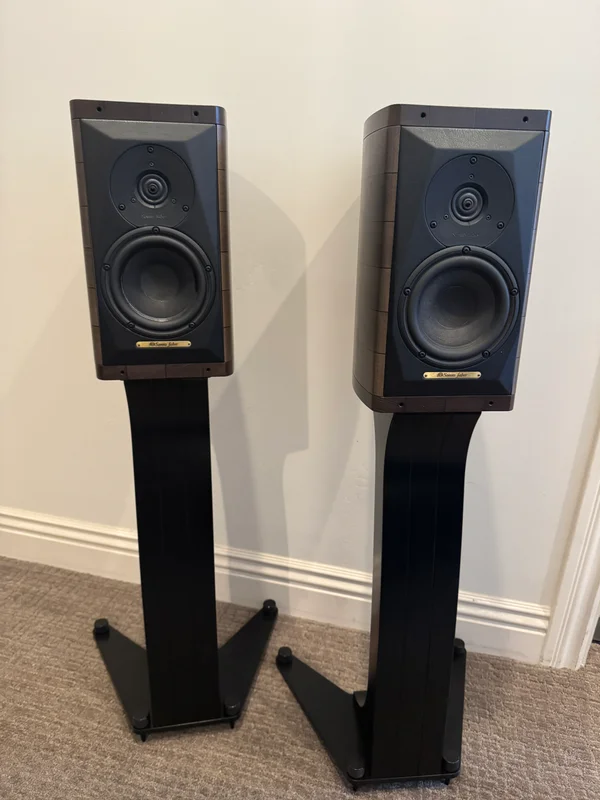
Sonus faber is one of the small handful of specialist speaker brands whose identity is inseparable from a specific place — Vicenza, Italy, a region historically famous for its violin makers. Founded in 1983 by a self-taught musician and craftsman, Sonus faber has spent more than forty years building loudspeakers that look and sound like instruments rather than electronics, using materials chosen for their musical character as much as for their measurement performance.
This Buyer’s Guide is Chapter 5 of the HiFi Registry series on the brands that define high-end audio. It exists because Sonus faber is unusual in the used market: the brand has no formal Certified Pre-Owned program, its extended warranty explicitly does not transfer to secondhand buyers, and its cabinet supplier is a small Italian family workshop that has been making Sonus faber cabinets since the mid-1980s. Understanding this landscape matters more for a used Sonus faber buyer than for buyers of most other high-end brands. If you’re considering a used Sonus faber purchase — Lumina, Sonetto, Olympica Nova, Homage collection (Guarneri, Serafino, Amati, Stradivari), or Reference collection (Aida, Il Cremonese, Suprema) — this guide is for you.
Sonus faber was founded in March 1983 in Vicenza, Italy by Franco Serblin (1939–2013), a musician and craftsman whose passion for both fine woodworking and hi-fi audio led him to design his own loudspeaker company. The name — Latin for “the maker of sound” — established from the start that Sonus faber saw itself as building instruments, not electronics.
Two facts about Sonus faber matter more to a used buyer than the reviews or the awards. First: the cabinets are hand-worked in Italy by a small family workshop that has been making Sonus faber cabinets for almost the entire life of the company, and the design philosophy prioritizes natural materials (wood, leather, silk domes) that are chosen for musical rather than measurement reasons. Second: the warranty landscape and authorized-dealer requirement — which we cover in the next section — makes the choice between dealer-consigned used and private-party used materially different for Sonus faber than for many other brands.
Model Timeline
The current Sonus faber lineup is best understood as five tiers of home speakers, with a small handful of specialist collections (Gravis subwoofers, Palladio custom install) sitting alongside.
The Warranty Landscape and Authorized Dealer Requirement
Unlike Wilson Audio, D’Agostino, or dCS, Sonus faber does not operate a formal Certified Pre-Owned program. What Sonus faber has instead is a distinctive warranty landscape combined with a strict authorized-dealer requirement that shapes the used-market decision differently. For a used buyer, understanding this landscape is more important than any single specification.
Because the vast majority of Sonus faber cabinets (all except Lumina) are made by the De Santi workshop near Vicenza, cabinet-level restoration or refinishing is a specific, coordinated process that involves both the Sonus faber factory and the De Santi partnership. Damaged cabinets on higher-tier models cannot be easily field-repaired by third-party finishers without loss of value; the authorized dealer network is the coordinated pathway back to factory-original condition.
What this means for a used buyer
First, for buyers of Homage-tier or Reference-tier speakers (Guarneri, Serafino, Amati, Stradivari, Aida, Suprema), the authorized-dealer channel matters materially more than for lower-tier models. Dealer-consigned or dealer-approved used units come with the assurance that they can be serviced by the authorized network; private-party units carry no factory warranty and require the new owner to establish a dealer relationship for future service.
Second, age matters for warranty. A used Sonus faber unit less than 2 years old with proof of original authorized-dealer purchase still carries transferable standard-warranty coverage. Units 3-8 years old with original registration have extended coverage on the passive loudspeaker components — but only for the original owner, not the used buyer.
Third, documentation matters more than for most brands. Original invoice from an authorized dealer, warranty registration confirmation, and original packaging together determine whether the unit can be brought back to factory-original condition through the authorized network in the future.
Fourth, the Italian craftsmanship story is genuinely different from the mass-produced high-end. A Sonus faber cabinet in good condition — the wood, lacquer, and leather elements that define the brand’s identity — represents artisan work that is difficult to replace. Cabinet condition is often the single largest factor in used-market pricing for the higher tiers, above driver condition or age.
Setup and Installation
Sonus faber setup considerations run different for different tiers of the range. The essentials that apply across the lineup:
Higher-tier Sonus faber speakers use the patented Z.V.T. (Zero Vibration Transmission) system to decouple the cabinet from the floor. The Amati Homage Tradition uses four knurled aluminum outrigger spikes with the ZVT system integrated to minimize vibration transmission. Setup requires attention to spike leveling and floor-protection considerations, particularly on hard floor surfaces where the cabinet weight becomes a factor.
Break-in period
Sonus faber does not publish a specific break-in target. Reviewer consensus across the range describes meaningful settling over the first week or so of play at reasonable volumes. Used units bought from a private seller are typically past break-in, which is a mild advantage; new-in-box units and dealer demos may benefit from 50-150 hours of continuous playback before serious evaluation.
Cabinet care
Because the cabinets are wood-and-lacquer with leather elements on higher-tier models, care is different from mass-produced high-end speakers. The multi-layer lacquer finish is durable but not scratch-proof; the leather requires periodic conditioning to maintain appearance. Cleaning should use only manufacturer-recommended products (typically damp microfiber and specific wood/leather care products) to avoid finish damage. Direct sunlight over time can affect both the wood veneer color and the leather. For used buyers evaluating a Homage-tier or Reference-tier unit, cabinet condition is often the single largest driver of pricing — a small scratch to the multi-layer lacquer can only be repaired through factory-coordinated refinishing.
Lumina III/V: small-to-medium rooms, 150-300 sq ft
Sonetto I/II G2: small-to-medium rooms, 150-300 sq ft
Sonetto III/V G2: medium rooms, 250-450 sq ft
Sonetto VIII G2: medium-to-large rooms, 350-550 sq ft
Olympica Nova II: medium rooms, 250-450 sq ft
Olympica Nova III/V: medium-to-large rooms, 350-600 sq ft
Guarneri Tradition: medium rooms, 200-400 sq ft
Serafino Tradition: medium-to-large rooms, 350-550 sq ft
Amati Tradition/G5/Supreme: large rooms, 400-700 sq ft
Stradivari/Il Cremonese/Aida: dedicated listening rooms, 500+ sq ft
Suprema: flagship listening rooms, 700+ sq ft
The most common mistake in the used Sonus faber market is buying too much speaker for the room — an Amati Supreme in a 250 sq ft space cannot produce the presentation it’s designed for. Room first, model second.
Break-in period care for used buyers
For a used unit that has been unpowered for months (typical of dealer demos or long-stored trade-ins), a shorter re-settling period of continuous playback at moderate volume before serious evaluation is a reasonable precaution, even though it won’t need the full week or so a brand-new pair takes to fully break in.
What to Look for Buying Used
Buying a used Sonus faber component is different from buying a used unit of most high-end brands. Cabinet condition, warranty transferability, original dealer origin, and the De Santi cabinet reality all matter to the buy/pass decision. Here’s what to check before committing.
Cabinet condition (the most important item on this list)
The multi-layer wood lacquer and leather elements are what make a Sonus faber a Sonus faber. Inspect under bright directional light: any scratches, dents, water rings, sun-faded areas, or leather damage. The multi-layer lacquer means small imperfections often can be polished out, but deeper damage requires factory-coordinated refinishing which is expensive and time-consuming. For Homage-tier and Reference-tier units, cabinet condition is typically the single largest driver of used-market value.
Grille condition
Sonus faber grilles vary by model — some are traditional fabric-covered, some incorporate leather stretched over the grille, some models (like Amati Supreme) don’t use conventional grilles at all. Grille damage is not always repairable through the factory pathway; check the specific model’s grille arrangement and confirm the grille (or its absence) matches the buyer’s preference.
Warranty documentation
Ask the seller for:
Original invoice from an authorized dealer (proves authorized-channel origin — required for any warranty coverage)
Warranty registration confirmation (proves extended warranty was activated within 30 days)
Original packaging including foam inserts (required for warranty-covered shipping)
The absence of any of these items reduces the unit’s ability to be brought back to authorized-network service later. This particularly matters for higher-tier units where the future value depends on factory-original condition.
Serial number verification
Contact your nearest authorized Sonus faber dealer or the Sonus faber distributor for your region with the serial number. The authorized network can typically verify authenticity, original ship date, and whether the unit has been through the authorized service network before. Grey-market units and counterfeit units (yes, they exist for Sonus faber, particularly for older Homage models) are identified this way. If a seller will not provide a serial number, do not proceed.
Driver condition
Visually inspect the tweeter (silk dome), midrange (paper or Camelia depending on tier), and woofers for damage: no dents, tears, or displacement. Ask about original condition and whether any drivers have been replaced. Voice-coil damage from overdriving is not always visible; ask about the previous owner’s amplifier and typical listening levels.
Crossover integrity
For units purchased second-hand at more than 5 years old, crossover components (particularly capacitors) may benefit from evaluation by an authorized dealer. Sonus faber uses ClarityCap capacitors custom-made for the brand in Olympica Nova III and above; component drift over years affects the specific voicing that defines the model.
Original dealer origin
Confirm the unit was originally sold through an authorized Sonus faber dealer. Grey-market units (typically imported through unauthorized channels to bypass regional pricing) do not qualify for extended warranty coverage in any circumstance and may face difficulty with authorized-network service.
Used Market Overview
The used market for Sonus faber has four patterns worth understanding before you shop.
Homage-tier holds value unusually well
The Guarneri, Serafino, and Amati models in the Homage collection depreciate slower than most peers, particularly the well-regarded Homage Tradition series (2017-onward). A used Amati Tradition from 2018 typically retains a higher percentage of original retail than most competing floorstanders at similar new prices. This reflects the Italian craftsmanship story, the difficulty of matching the wood-cabinet aesthetic elsewhere, and the collectors’ interest in the Homage line specifically.
Lumina and Sonetto depreciate faster
Entry-tier Sonus faber depreciates similarly to other quality mid-market speakers — buyers should expect meaningful discount for 2-3 year old units. Sonetto G2 as the newest refresh will likely hold value through 2026-2027 given its recency, but original Sonetto (pre-G2) has depreciated meaningfully.
Historical Homage models are collector items
The original Guarneri Homage (1993), Amati Homage (early 2000s), Stradivari Homage (2004), and Amati Anniversario command strong secondary-market prices among collectors. These models sit outside the standard used-market analysis: they trade based on collectibility and historical significance more than sonic performance-per-dollar. If you’re considering a historical Homage model, expect prices above equivalent-tier current models.
Dealer-consigned premium is significant
Because Sonus faber’s warranty landscape makes private-party purchase materially different from authorized-dealer purchase, dealer-consigned used Sonus faber typically commands a meaningful premium over private-party equivalent. This reflects: dealer inspection and reconditioning, dealer-provided limited warranty, and future service pathway through the same dealer relationship. For Homage-tier and Reference-tier units, the premium is often worth paying.
Where used Sonus faber tends to appear
Most authorized-network used-market activity happens through Sonus faber dealers on trade-in or consignment. Private-party listings appear on HFR, Audiogon, US Audio Mart, and specialist forums. Grey-market units appear from time to time; these carry the warranty caveats above and typically trade at meaningful discount.
HFR Value Retention story for Sonus faber
Two of HFR’s Value Retention metrics work well for Sonus faber. First is Cabinet Aesthetic Longevity: the wood-and-leather cabinets age with character rather than obsolescence, and well-maintained units look as compelling ten years later as when new. Second is Brand Reference Longevity: Sonus faber’s design language (Homage lute-shape) has been consistent for over 30 years, meaning historical models remain visually recognizable and desirable. Buyers considering Sonus faber for long-hold ownership have a strong supporting case, particularly at the Homage tier.
Room and System Matching
Sonus faber’s design philosophy — Natural Sound, warm and forgiving voicing, wood-and-leather cabinets — creates specific pairing patterns that a used buyer should understand.
Natural upstream partner: McIntosh
Because Sonus faber and McIntosh have been under the same corporate ownership since the mid-2010s (Fine Sounds → McIntosh Group → Highlander Partners → Bose Corporation), the two brands have been designed to complement each other and are the most common flagship pairing shown at dealer events. McIntosh’s warm, harmonically-rich tube and solid-state amplification pairs beautifully with Sonus faber’s voicing — the combined presentation is dominant in demonstration rooms and Sonus faber marketing material. For used buyers who want the “intended” Sonus faber sound, McIntosh electronics are the safest choice.
Beyond McIntosh: warm-neutral solid-state and revealing tube
Sonus faber speakers pair well with high-quality solid-state amplification from Burmester, D’Agostino, Krell, Pass Labs, and Boulder — a natural warmer solid-state pairing style alongside Sonus faber’s own McIntosh partnership. Higher-power tube amplification from VTL, Audio Research, and Nagra also pairs well with Homage and Reference tier Sonus faber — the tube presentation complements the natural wood-cabinet voicing without becoming syrupy.
Common mismatches
Small SET (single-ended triode) designs are typically a mismatch with Homage-tier and up. Even though Sonus faber sensitivities are reasonably high (Amati Supreme at 91dB, Olympica Nova III at 90dB), the impedance curves are 4-ohm nominal and drop lower in bass regions.
Very cool or clinical solid-state amplification can strip the warmth that makes Sonus faber Sonus faber. Cool-sounding amplifiers (some class-D designs, some heavily-filtered digital amps) tend to fight the speaker’s natural voicing rather than complement it.
Power requirements by tier
Lumina, Sonetto I/II G2: 50W-150W into 8Ω is sufficient. Most competent integrated amplifiers work well.
Sonetto V/VIII G2: 100W-250W into 8Ω recommended. Moderate-power integrateds or entry-level separates handle these speakers well.
Olympica Nova II/III: 100W-300W into 8Ω. The bar rises here — quality solid-state or higher-power tube amplification.
Olympica Nova V: 150W-400W into 8Ω. Genuine high-current amplification recommended.
Guarneri Tradition: 60W-200W into 8Ω. Guarneri is unusually amp-friendly for its tier.
Stradivari/Il Cremonese/Aida/Suprema: flagship-tier amplification only. D’Agostino Momentum or Progression, Boulder 2100 series, VTL Siegfried, Nagra HD, CH Precision M10, or the McIntosh flagship monoblocks.
Source components
Because Sonus faber’s voicing is warm and forgiving, revealing digital sources (dCS Rossini or Vivaldi, MSB Reference, Weiss DAC) work beautifully — the speakers accept the resolution without becoming clinical. For vinyl, the natural pairings are Clearaudio, Kuzma, or VPI turntables with high-quality moving-coil cartridges (Sumiko is under the same corporate ownership and is the natural partner). Sonus faber does not have a specific “house” source component, but the Sumiko cartridge connection is worth understanding for buyers thinking about ecosystem synergy.
Frequently Asked Questions
What's the difference between Lumina, Sonetto G2, Olympica Nova, Homage, and Reference collections?
The five tiers represent progressive levels of craftsmanship, materials, and price, with the Homage and Reference collections representing Sonus faber's heritage identity. Lumina is Sonus faber's most accessible tier ($1,499-$2,399/pair for standmounts), the only line with cabinets outsourced to China. Sonetto G2 (refreshed at High End Munich 2024) sits above Lumina with Italian cabinets and DAD tweeter technology derived from Suprema. Olympica Nova is the mid-tier evolution ($7,000-$16,500/pair) with the signature asymmetrical lute-shape cabinet and ClarityCap custom capacitors. Homage collection (Guarneri, Serafino, Amati, Stradivari, plus new Amati Supreme) is the heritage tier at $21,900-$78,000/pair, with wood-and-leather cabinets in the lute shape that established the brand's identity. Reference collection (Aida, Il Cremonese, Lilium, Suprema) represents flagship-tier work at $100,000-$750,000.
Does Sonus faber have a certified pre-owned program?
No — Sonus faber does not operate a formal Certified Pre-Owned program like Wilson Audio or dCS. What Sonus faber has instead is a distinctive warranty structure combined with a strict authorized-dealer requirement. Standard warranty is 2 years from original purchase by the original owner; extended warranty (registered within 30 days of purchase) provides 8 years on passive loudspeaker components. Critically, the extended warranty is explicitly non-transferable and does not apply to private secondhand sales. Buying used Sonus faber through an authorized dealer typically includes a dealer-provided limited warranty and future service pathway; buying private-party requires the new owner to establish an authorized dealer relationship for any future service.
Does my Sonus faber warranty transfer when I sell my speakers?
The extended warranty is explicitly non-transferable to private secondhand sales — the buyer of a private-sale unit inherits none of the original warranty coverage. This is meaningfully more restrictive than Wilson's or dCS's warranty transfer policies. For the 2-year standard warranty, transferability is not explicitly addressed in Sonus faber's warranty policy but proof of purchase from an authorized retailer is required for any warranty claim. For the extended warranty (8-year on passive loudspeakers), Sonus faber's policy explicitly states it applies only when the product was purchased from an authorized retailer and is non-transferable. Practical implication: dealer-consigned used Sonus faber (where the dealer typically provides its own limited warranty) is materially different from private-party used, and typically commands a premium reflecting that assurance.
Can I have factory refinishing done on my Sonus faber cabinet?
Cabinet refinishing on Sonus faber speakers is a coordinated process through the authorized dealer network, not a direct-to-factory service. Because the vast majority of Sonus faber cabinets (all except Lumina) are made by the De Santi family workshop near Vicenza, cabinet-level repair or refinishing requires coordination between Sonus faber and De Santi. This is not something the average field-service technician can perform; damaged cabinets on higher-tier models typically require the unit to be sent back to Italy or worked on through an authorized dealer with factory support. Contact your nearest authorized dealer with the specific model and damage description — they will coordinate the pathway and provide pricing. Small imperfections in the multi-layer lacquer can sometimes be polished out; deeper damage is more involved.
What amplifiers does Sonus faber recommend with their speakers?
Sonus faber's natural upstream partner is McIntosh — the two brands have been under the same corporate ownership since the mid-2010s and are designed to complement each other. McIntosh amplification pairs beautifully with Sonus faber voicing across the range, from Sonetto through Suprema. Beyond McIntosh, Sonus faber speakers pair well with warm-neutral solid-state from Burmester, D'Agostino, Krell, Pass Labs, and Boulder. Higher-power tube amplification from VTL, Audio Research, and Nagra also pairs well with Homage and Reference tier Sonus faber. Common mismatches include small single-ended triode designs (impedance curves drop below 4Ω in bass regions) and cool/clinical class-D designs that fight the speaker's natural warmth. Power requirements scale with the tier: Lumina 50-150W is sufficient; Amati Supreme calls for 50-600W per Sonus faber's own spec.
Are Lumina cabinets made in Italy?
No — Lumina is the only Sonus faber line with cabinets outsourced to China, while the rest of the range uses Italian cabinet manufacturing. Sonetto G2, Olympica Nova, Homage collection, Reference collection, Gravis subwoofers, and Palladio custom install all use Italian cabinet manufacturing. The vast majority go through the De Santi family workshop near Vicenza — a partnership that has been in place since the mid-1980s and is now run by Stefano De Santi, son of the original Luciano DeSanti. Lumina cabinets are outsourced to keep the entry tier accessible, but the acoustic design, driver selection, and voicing remain Italian. For buyers who specifically want Italian-made Sonus faber cabinets, any model from Sonetto G2 or above meets that requirement.
Who makes the cabinets for the higher-tier Sonus faber speakers?
The De Santi family workshop, located near Vicenza, has made almost every non-Lumina Sonus faber cabinet since the mid-1980s. De Santi originally specialized in grandfather clocks when Franco Serblin discovered them and commissioned them to make Sonus faber cabinets. The partnership has grown collaborative over the years — De Santi's main business is now Sonus faber cabinet work. The workshop is currently run by Stefano De Santi, son of the original Luciano DeSanti. Cabinets are hand-worked using traditional woodworking techniques adapted for the specific acoustic requirements of each Sonus faber model. This partnership is the reason cabinet refinishing and restoration on higher-tier Sonus faber models involves a specific coordinated pathway rather than generic third-party service.
How does the Bose acquisition affect Sonus faber?
Bose Corporation acquired McIntosh Group (Sonus faber's parent company), with the deal publicly announced in November 2024, but Sonus faber's day-to-day manufacturing, product roadmap, and dealer network continue in Vicenza with no changes announced for owners. The acquisition transferred ownership from Highlander Partners (a Dallas-based private equity firm that had owned McIntosh Group since June 2022) to Bose Corporation. Bose has publicly stated that Sonus faber will maintain its focus on amplifiers, loudspeakers, turntables, and other high-end products, and the company remains based and manufacturing in Vicenza as it always has. The most notable potential future direction is Bose's automotive-audio expertise combined with Sonus faber's existing partnerships with Pagani and Maserati. For current Sonus faber owners and used-market buyers, warranty policy, dealer network, and service pathways continue unchanged from pre-acquisition.
What's the difference between the Homage Tradition series and the Amati G5/Supreme?
Homage Tradition was the 2017 generation of the Homage collection; Amati G5 was a later-generation Amati; Amati Supreme (2025) is the newest and inherits driver technology directly from the flagship Suprema. The Homage Tradition series launched in 2017 with Amati Tradition ($29,900/pair) and Serafino Tradition ($21,900/pair), continuing the Cucuzza-Tezzon design era. The G5 designation refers to a later generation of the Amati specifically. Amati Supreme is a new addition in 2025 that uses the same silk-dome tweeter, super tweeter, Camelia midrange, and cork acoustic chamber found in the flagship Suprema — packaged in a $78,000 floorstander with matte metal finish rather than the traditional wood. Amati Supreme sits alongside Amati G5 rather than replacing it, giving buyers two current Amati options at different price points.
How do I find an authorized Sonus faber dealer for service or CPO-equivalent purchase?
Sonus faber distributes through a global network of authorized specialist retailers. In the United States, HiFi Registry's anchor Sonus faber dealer is LMC Home Entertainment (Scottsdale/Tempe, Arizona). LMC handles Sonus faber sales, dealer-consigned used inventory, and service coordination for the Southwest region. For buyers outside the Southwest, Sonus faber's dealer locator on their official website (sonusfaber.com) lists all authorized dealers globally. All sales and service go through the authorized dealer network — Sonus faber does not sell direct from the factory, and grey-market units purchased through unauthorized channels do not qualify for extended warranty coverage. For factory-coordinated service or cabinet refinishing, an authorized dealer coordinates the pathway; owners never ship directly to Sonus faber's Vicenza factory without dealer involvement.
Authorized Dealers on HFR
Sonus faber distributes through a global network of authorized specialist retailers. Authorized-dealer status matters with Sonus faber because all warranty coverage, cabinet refinishing, and factory-coordinated service go through that same dealer channel.
Authorized dealers can facilitate warranty claims, coordinate cabinet refinishing through the De Santi pathway, and run a serial number against the authorized network. Buyers considering a used Sonus faber purchase from a private party should still consider engaging with a local authorized dealer for a pre-purchase check.
Asking price compared against 8 market transactions averaging $3,024, ranging from $2,200 to $3,995. Compiled from completed sales across the used market, not HiFi Registry transactions.
A curated bibliography of the sources cited throughout this Buyer’s Guide chapter. All specialist reviews and manufacturer materials referenced in the sections above are indexed here.
 Authorized dealer