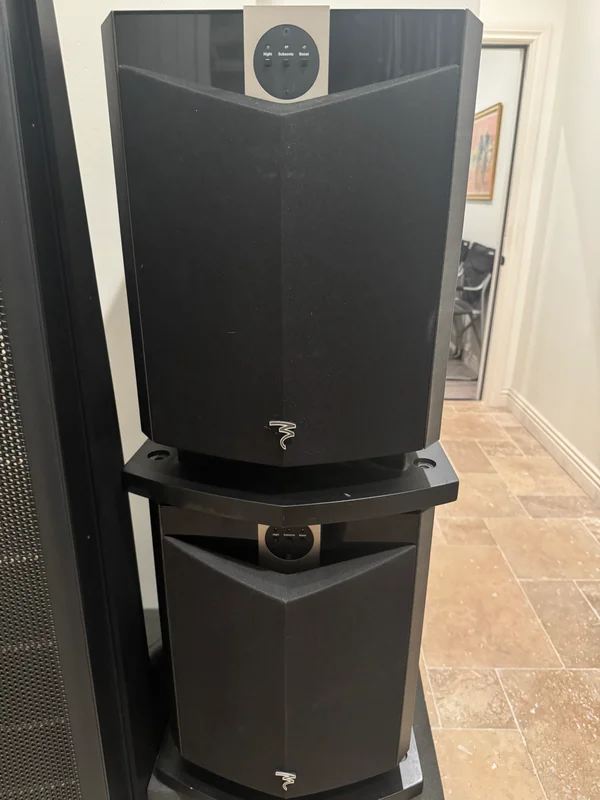
 Authorized dealer
7cond
A chapter of HFR’s Complete Buyer’s Guide to High-End Audio
Focal is one of the only speaker companies in the world that makes its own drivers, its own wood cabinets, and its own beryllium tweeter domes, all under one roof in Saint-Étienne, France. That vertical integration — rare even among high-end manufacturers — is the throughline connecting a $900 bookshelf speaker to a $280,000 flagship, and it has stayed intact through a genuinely unusual amount of corporate change: as of May 2026, Focal is owned by Barco, a Belgian projection and audiovisual technology company, its third financial owner since 2019.
None of that ownership churn has touched the engineering. The beryllium inverted-dome tweeter — shaped in-house via a process only a handful of companies worldwide can do at industrial scale — and the W-composite sandwich cone have anchored Focal’s sound since the 1990s and 1995 respectively, and they still define the current Utopia flagship line.
This guide covers Focal’s history and ownership chain, its design philosophy, the Utopia generational lineage through the new Diva Alta Utopia, the current product line, service and warranty reality, and — critically — what to do if a used pair’s beryllium tweeter is damaged.
2 active Focal listings on HFR.
Focal-JMlab was founded in 1979 in Saint-Étienne, France, by Jacques Mahul, an engineer with a passion for music and hi-fi, in a workshop hosted by his father’s precision-engineering company. From the outset the company operated under two connected brand names within one entity: Focal for the raw speaker drivers it sold to other manufacturers and DIY builders, and JMlab for the complete loudspeaker systems it built itself. A car audio division followed a decade later, created in 1989.
The breakthrough that put Focal on the map came in 1995 with the original Grande Utopia, the company’s first flagship. It introduced the W-composite sandwich cone — a construction balancing lightness, rigidity, and damping — and used a titanium dome tweeter with a titanium-dioxide vapor-deposited coating that Focal marketed as “Tioxid.” The tweeter that would come to define Focal’s sound arrived a few years later: a pure beryllium inverted dome, the product of roughly three years of research and development, debuted in the Utopia Be generation in the early 2000s.
Focal-JMlab and the British electronics maker Naim Audio merged in August 2011, and in 2014 the combined operation was formalized as the Vervent Audio Group holding company. Alpha Private Equity, a European private equity firm, acquired a majority stake in Vervent in 2019, installing Cédrick Boutonet as CEO of the combined Focal and Naim operation.
That arrangement changed again in 2026. On March 9, 2026, Barco NV — a Belgian company best known for projection and visualization technology — announced an agreement in principle to acquire 100% of VerVent Audio Holding from Alpha Private Equity for an enterprise value of approximately €135 million, against VerVent’s roughly €110 million in annual revenue, funded entirely from Barco’s own cash. Barco CEO An Steegen framed the deal as part of a strategy to “deliver fully integrated solutions where image and sound reinforce each other seamlessly.” The transaction closed on May 13, 2026 — VerVent confirmed completion that day — and Focal and Naim now sit inside Barco’s Entertainment division. Boutonet remains CEO of Focal and Naim, saying the move lets the companies “create a stronger and global audiovisual leader, accelerating growth and innovation while staying true to what makes our brands special.”
Manufacturing has stayed constant through all of it. Focal still designs and builds its drivers, wood cabinets, and beryllium tweeter domes at Saint-Étienne, and VerVent’s global retail network — more than 80 dedicated “Focal Powered by Naim” boutiques plus thousands of additional points of sale — continues to operate under the new ownership.
Focal’s single biggest differentiator from almost every other speaker manufacturer, French or otherwise, is that it makes its own drivers rather than buying them from an OEM supplier — and within that, its ability to shape pure beryllium into a tweeter dome in-house is something only a small number of companies anywhere can do at industrial scale.
Beryllium is so rigid it is the only metal that can scratch glass. For a dome of identical mass, it is roughly seven times stiffer than titanium or aluminum, and sound travels through it about three times faster than through titanium and two and a half times faster than through aluminum. Those properties let Focal’s beryllium tweeter, shaped with an “M” profile that balances rigidity, lightness, and damping, cover more than five octaves — 1,000Hz to 40,000Hz — from a single dome. Focal shapes the inverted dome itself, a manufacturing capability the company describes as a world first when it launched, and beryllium’s cost (Focal notes it runs roughly 100 times the price of gold) is a large part of why the technology stays confined to Focal’s upper tiers.
Debuting alongside the beryllium tweeter’s predecessor in the 1995 Grande Utopia, the W-composite cone sandwiches a structural core between two skins to hit three properties simultaneously that are normally in tension with each other: lightness, rigidity, and damping. The construction has evolved over three decades but remains the basis for Focal’s cone drivers across the current lineup.
NIC is Focal’s motor-system technology: a Faraday ring sized, positioned, and material-selected to keep the driver’s magnetic field stable as the voice coil moves through it. A stable field means more consistent, predictable driving-amplifier control over the cone across its full excursion — in practice, lower distortion.
Introduced in 2015 with the launch of the Sopra line, TMD adds small, precisely positioned toroidal weights to a driver’s suspension to damp a specific breakup behavior that shows up in the 1–2kHz range on conventional suspensions. It has since spread from Sopra into Kanta and other current lines.
IAL2 (Infinite Acoustic Loading, second generation) is Focal’s tweeter-chamber technology, still used across the current Utopia III Evo line to control the rear wave behind the beryllium dome. Focus Time refers to Focal’s practice of arranging a speaker’s drivers in an arc oriented toward the listening position, so that sound from the tweeter, midrange, and bass drivers — which would otherwise arrive at slightly different times because of their physical offset — reaches the listener’s ears simultaneously.
Gamma Structure houses each driver — tweeter, midrange, and woofer — in its own independent, anti-vibration MDF sub-enclosure within the cabinet, isolating each from the others’ resonances. Power Flower is Focal’s multiferrite magnet motor design, built for high transmitted magnetic energy alongside optimized cooling. Both are current Utopia III Evo technologies.
All of it — drivers, cabinets, and the beryllium domes themselves — is designed and built at Focal’s Saint-Étienne facility, not outsourced to a components supplier. That vertical integration is unusual in high-end audio and is a large part of why Focal can iterate its driver technology (Continuum-style cone evolutions, new tweeter geometries, new magnet designs) on its own timeline rather than a supplier’s.
Focal’s flagship lineage runs in clear generational steps from the original Grande Utopia through today’s Utopia III Evo — and, as of the past two years, into an entirely new active-speaker category under the Utopia name.
Focal’s first flagship and the debut of the W-composite cone, launched with a titanium “Tioxid” tweeter rather than beryllium.
The Utopia Be generation introduced Focal’s first beryllium tweeter, the product of roughly three years of development. Stereophile’s review of the Grande Utopia Be ran in September 2003, giving a sense of how quickly the technology moved from launch to critical attention.
The second-generation flagship platform, spanning the Grande Utopia EM, Stella Utopia, Maestro Utopia, Scala Utopia, and Diablo Utopia — the range structure that, in updated form, still defines the current lineup.
The current flagship generation, rolled out starting with the Scala, Maestro, and Diablo Utopia Evo models before the range-topping Grande Utopia EM Evo and Stella Utopia EM Evo were added to complete the line. Evo brings updated beryllium and W-composite driver technology, IAL2 tweeter loading, and refined Gamma Structure cabinets to the Utopia III platform.
The debut platform for TMD suspension technology, positioned as Focal’s reference tier below Utopia.
A premium tier built around a visually distinctive driver (a linen-cone midrange/woofer, in place of the yellow-toned W-composite look of Focal’s other lines) and colored lacquer side-panel finishes — Kanta is as much a design statement as an engineering one.
Vestia launched in 2023 as a five-product line — bookshelf through floorstander plus center channel — positioned as Focal’s core hi-fi tier. It runs alongside, rather than strictly replacing, the longer-running Aria line, which Focal has continued to update as Aria Evo X, carrying forward the linen-membrane driver approach that dates back to the original 2014 Aria.
Focal’s current entry point into high-fidelity speakers, spanning bookshelf, floorstanding, and center-channel models built for smaller rooms and budgets.
Diva Utopia is a genuinely new category for Focal: its first active, wireless, connected loudspeaker, combining Focal acoustics with Naim-developed amplification and streaming in a single cabinet — no separate amplifier or source required. The original Diva Utopia launched October 2, 2024 at $39,999 per pair, sold exclusively through the Focal Powered by Naim network. Focal has expanded the family quickly: the larger Diva Mezza Utopia followed in 2025 at $69,000 per pair, and the flagship Diva Alta Utopia was announced in June 2026 at $210,000 per pair, available from August 2026, with a new-generation PRISM tweeter, the M-profile W midrange driver, and 600 watts of Naim-developed amplification built in, optimized for rooms up to nearly 1,300 square feet.
Focal does not publish list pricing directly on focal.com; the figures below are representative US pricing gathered from authorized dealers, current as of this writing, and should be confirmed with a dealer for a specific finish or configuration.
Scala Utopia Evo ~$40,000/pr · Maestro Utopia Evo ~$76,000/pr · Stella Utopia EM Evo ~$150,000/pr · Grande Utopia EM Evo ~$280,000/pr · Diablo Utopia Evo also current (standmount, pricing varies by dealer). Focal doesn’t publish these prices itself — figures are per-pair, doubled from Upscale Audio’s published per-speaker pricing.
Sopra N°1 through N°3 plus a matching center channel, roughly $13,000–$27,000/pr depending on model and finish.
Kanta N°1 through N°3 plus a matching center channel; Kanta N°2 runs approximately $12,000/pr.
Five products spanning bookshelf to floorstander plus center: N°1 ~$1,200/pr, N°2 ~$2,900/pr, N°3 and N°4 higher, scaling with cabinet size.
N°1 ~$1,100/pr, N°2 ~$2,000/pr, N°3 ~$2,600/pr, plus a center channel — Focal’s most accessible current tier.
Diva Utopia $39,999/pr · Diva Mezza Utopia $69,000/pr · Diva Alta Utopia $210,000/pr (available August 2026) — active, wireless, Naim-amplified all-in-one speakers, sold only through Focal Powered by Naim.
Focal’s headphone range (Utopia, Stellia, Clear MG, Bathys, Elegia, Elear, Elex, and others) and its Focal Professional studio monitor line (Solo6, Twin6, Trio6, Trio11, SM9, Alpha, Shape) are both current and well-regarded, but this guide focuses on the high-end passive home loudspeakers that dominate Focal’s used market.
Focal America’s published warranty terms set two tiers, both non-transferable: one year from date of purchase for a speaker bought from an authorized retailer, extending to three years if the speaker was purchased from and installed by an authorized retailer with no outside alterations to the setup. Products bought from an unauthorized retailer carry no Focal warranty at all. Either way, a used pair bought from a second owner carries no factory warranty regardless of the original speaker’s age.
We found no evidence of a factory CPO program for customer-owned used Focal speakers. The used market for Focal is dealer- and private-party-mediated only — there is no equivalent of the recertification programs some other high-end speaker brands run. That makes inspection and provenance the buyer’s responsibility on a used purchase, not something a factory program does for you.
Because Focal builds its own drivers in-house, replacement parts for current-generation speakers flow through authorized dealers back to the factory. A damaged beryllium tweeter dome is replaced as a complete factory-supplied module through an authorized dealer or Focal service — it is not a repairable or DIY-serviceable part. We could not independently verify parts depth for legacy Utopia III (2008–2018) or pre-2015 models specifically; confirm availability with Focal or an authorized dealer before buying an older pair that will need service.
Beryllium tweeter safety comes first. If a Focal beryllium dome is torn, dented, or crushed, do not touch it, sand it, vacuum it, or attempt any cleanup yourself. Beryllium dust is a recognized occupational hazard — the U.S. Occupational Safety and Health Administration classifies beryllium as a human carcinogen and documents serious lung disease from inhaling airborne beryllium particles. A damaged dome should be left alone and referred to an authorized Focal dealer or Focal service for professional handling and factory-supplied replacement. This is not a DIY repair under any circumstances.
Before anything else, look closely at the tweeter dome. It should be smooth, evenly domed, and free of visible dents, tears, or discoloration. If it looks damaged in any way, treat the speaker per the warning above and do not proceed with a hands-on inspection of that driver.
The W-composite midrange and bass cones are a sandwich construction — check for delamination (visible separation between the outer skin and the core, or a soft/spongy feel compared to a firm, uniform surface) and any creasing or puncture damage.
Focal’s gloss lacquer finishes chip at corners and edges more readily than satin finishes; on Utopia’s curved cabinet sides, check for veneer or lacquer separation along the curve. Kanta’s colored lacquer finishes are distinctive and correspondingly harder to touch up invisibly if damaged — factor cosmetic condition into price more heavily on Kanta than on more conventionally finished models.
On Utopia and Sopra models using Focus Time geometry, confirm the driver modules are securely attached and properly aligned — loose or shifted module mounting affects the time-alignment the whole design depends on.
Newer models use magnetic grille attachment; confirm grilles are present and undamaged if originally included. Check that binding posts and any biwiring hardware are intact and not stripped.
Ask for photos of serial plates and any original purchase documentation. Because there is no factory certification program to lean on, a seller who can speak clearly to the speakers’ ownership and service history is doing more of the trust-building work than the transaction otherwise would.
Focal’s used market splits fairly clearly by tier. Utopia and Kanta pairs tend to hold buyer interest — Utopia on the strength of the in-house beryllium/W-composite engineering, Kanta on its visual distinctiveness — while Vestia and Theva, positioned as accessible current-production lines, depreciate faster and more in line with typical mainstream high-fidelity speakers.
Generational transitions compress prices for the outgoing model, the same pattern seen across high-end audio generally: when Utopia III Evo replaced Utopia III starting in 2018, earlier Utopia III pairs saw softer secondary-market demand as buyers gravitated to the updated driver technology. We did not find a rigorous, sourced percentage for that compression specifically, so treat it as a directional pattern rather than a precise figure.
Focal’s installed base in Europe is considerably larger and longer-established than in the US, which can mean more used inventory and softer pricing in European markets specifically — a reasonable expectation given the company’s French origin and long-standing European retail network, though we did not find a rigorous US-vs-Europe pricing comparison to cite directly.
The new Diva Utopia family is worth a separate note for future used buyers: as an active, networked speaker with built-in amplification and streaming, its long-term value depends partly on Focal and Naim’s continued software and firmware support — a different risk profile than a passive speaker, which has no electronics to become obsolete. This is a new consideration for Focal buyers that simply didn’t exist before 2024.
Focal’s own published specifications look easy to drive: the Scala Utopia Evo is rated at a nominal 8 ohms with a 3.2-ohm minimum and 92dB sensitivity, well short of the sub-2-ohm dips some competing flagship speakers present on paper. Treat that as a starting point rather than the full picture, though — it’s the manufacturer’s own spec, not an independent bench measurement, and Focal’s Sopra line (which shares much of the same driver philosophy) has measured tougher in third-party testing than its spec sheet suggests, with owners and reviewers noting real current demands in the upper bass. A genuinely current-capable amplifier is still worth budgeting for, even though Focal’s numbers are less extreme than some rivals’.
Naim has been Focal’s sibling brand since the 2011 merger and remains one under Barco, formalized through the “Focal Powered by Naim” retail concept and, most directly, through the Diva Utopia family’s built-in Naim amplification. For a buyer who wants a single-brand-family system with a demonstrated pairing pedigree, Naim electronics are the obvious starting point.
Focal’s healthy published sensitivity numbers still leave room for a wide range of partners: the speakers show up regularly with high-current solid-state amplification from Pass Labs, Boulder, Dan D’Agostino, Krell, and McIntosh in dealer demonstrations and reviews. There is no single official third-party amplifier partner — Naim is the in-family option, and everything else is a matter of taste and system-building rather than a compatibility requirement.
Follow cabinet size as a practical guide: Theva and the smaller Vestia models suit modest rooms, Sopra and Kanta want a mid-size dedicated listening space, and the larger Utopia III Evo models — particularly the Stella and Grande Utopia EM Evo — need a genuinely large room to develop their full output without overwhelming it. The Diva Alta Utopia is explicitly specified for rooms up to nearly 1,300 square feet, well beyond what the original, smaller Diva Utopia was designed for.
As of May 13, 2026, Focal is owned by Barco NV, a Belgian projection and audiovisual technology company, following its acquisition of VerVent Audio Holding (Focal and Naim’s parent company) from Alpha Private Equity. The deal was announced as an agreement in principle on March 9, 2026, valued at approximately €135 million, and closed a little over two months later. Focal and Naim now sit inside Barco’s Entertainment division. This is Focal’s third change of financial ownership since 2019.
Yes. Focal designs and manufactures its drivers, wood cabinets, and beryllium tweeter domes in-house at its Saint-Étienne, France facility, and that has not changed through any of the recent ownership transitions. Saint-Étienne has been Focal’s home since Jacques Mahul founded the company there in 1979, and it remains the manufacturing base for the Utopia, Sopra, Kanta, and Vestia lines.
Utopia III Evo is the current flagship generation, comprising the Scala, Maestro, Diablo, Stella, and Grande Utopia EM Evo models. It succeeded the original Utopia III (2008–2018) with updated Beryllium and W-composite driver technology, IAL2 tweeter loading, and refined Gamma Structure cabinets. Focal has also begun expanding the Utopia name into a new active-speaker category with the Diva Utopia family.
Beryllium is an ultra-rigid, ultra-light metal Focal shapes into an inverted dome tweeter in-house at Saint-Étienne — it is completely safe in normal use, sealed inside the speaker exactly like any other tweeter dome. The safety question only applies if the dome is physically damaged. Beryllium dust is a recognized occupational health hazard — OSHA classifies beryllium as a human carcinogen and inhalation risk when airborne — so a cracked or crushed dome should never be touched, sanded, or handled. See the Buying Used section below for what to do instead.
Do not touch it. Do not attempt to clean, sand, or remove a torn or crushed beryllium dome yourself — disturbing damaged beryllium can release dust that is toxic if inhaled. Contact an authorized Focal dealer or Focal service directly. Replacement is handled through authorized channels with a factory-supplied module; beryllium domes are not a DIY or third-party repair item.
They’re three different tiers below the Utopia flagship: Sopra is Focal’s upper-mid reference line (debuted 2015, introduced the TMD suspension), Kanta is a premium tier built around a visually distinctive linen-cone driver and colored lacquer finishes (2017), and Vestia is Focal’s core hi-fi tier (2023), positioned below Sopra and Kanta on price. All three share Focal’s in-house driver manufacturing, but only the Utopia and Sopra lines carry the beryllium tweeter — Kanta and Vestia use Focal’s aluminum/magnesium or TNF tweeter designs instead.
No. Focal does not run a factory certified-pre-owned program for privately owned used speakers. The used Focal market is entirely dealer- and private-party-mediated. Focal’s standard warranty (1 year, or 3 years if installed by an authorized dealer) is explicitly non-transferable, so a used pair carries no factory warranty regardless of age — factor that into how you evaluate condition and provenance.
Naim — Focal’s sibling brand since 2011 and now a fellow Barco-owned company — is the most natural pairing, formalized through the “Focal Powered by Naim” retail concept sold in 80+ dedicated stores worldwide. Focal publishes reasonably forgiving specifications (the Scala Utopia Evo, for example, is rated a nominal 8 ohms with a 3.2-ohm minimum), so the speakers also pair well with a wide range of solid-state amplification beyond Naim, including Pass Labs, Boulder, Dan D’Agostino, Krell, and McIntosh in dealer demonstrations and reviews — though a genuinely current-capable amplifier still matters, since independent bench measurements of related Focal models have shown tougher real-world loads than the spec sheet alone suggests.
Focal-JMlab and Naim Audio merged in August 2011, and the combined entity was formalized as the Vervent Audio Group holding company in 2014. That structure stayed in place through Alpha Private Equity’s 2019 majority-stake acquisition and up to the 2026 Barco deal — Focal and Naim have operated as sibling brands under one parent for 15 years now, regardless of who owns the parent.
A co-branded specialty retail concept — dedicated showrooms built around demonstrating Focal speakers and Naim electronics together, rather than either brand alone. There are more than 80 of these boutiques worldwide as part of VerVent’s broader global retail and distribution network, which also includes thousands of additional points of sale for Focal and Naim products outside the co-branded stores.
Diva Utopia is Focal’s first-ever active, wireless, connected loudspeaker family — a genuinely new product category for a company that had only ever made passive speakers before. The original Diva Utopia launched October 2, 2024 at $39,999/pair. Focal has expanded it fast: the Diva Mezza Utopia followed in 2025 at $69,000/pair, and the flagship Diva Alta Utopia was announced in June 2026 at $210,000/pair, on sale from August 2026, with 600 watts of Naim-developed amplification built in.
Yes, particularly at the Utopia and Kanta tiers, where Focal’s in-house engineering and distinctive design hold buyer interest well on the secondary market. The absence of a factory CPO program means there’s no manufacturer-backed safety net on a used purchase, so inspection quality — especially of the beryllium tweeter and W-composite cones — and seller documentation matter more than they would with a brand that recertifies used pairs.
LMC Home Entertainment, HFR’s anchor dealer for several other brand chapters, does not carry Focal. For current authorized dealers, Focal maintains a store locator at focal.com/distributors; two regional US “Focal Powered by Naim” dealers verified directly for this guide:
Located within the DeVance Electronic Lifestyle store at 2323 Tarpley Road, Suite 112, Carrollton, TX. Features dedicated demonstration rooms and a headphone bar.
Operated by AV Luxury Group in Downtown Summerlin, 2130 Park Centre Drive, Las Vegas, NV. A 200 m² space with demonstration rooms and a headphone bar.
No authorized Focal dealers are listed on HFR yet. Check back as HFR’s dealer network grows.
Authorized dealer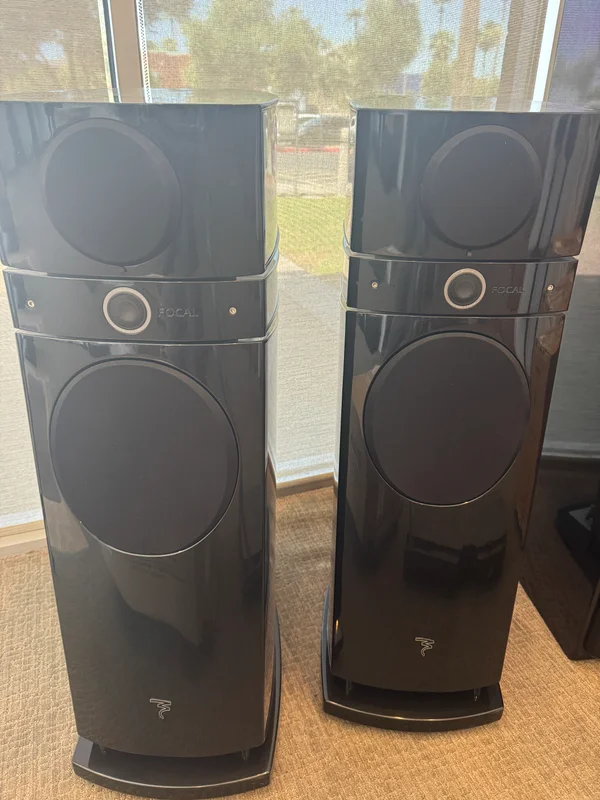 Authorized dealer
Asking price compared against 8 market transactions averaging $31,654, ranging from $15,999 to $52,998. Compiled from completed sales across the used market, not HiFi Registry transactions.
A curated bibliography of the sources cited throughout this Buyer’s Guide chapter. All specialist reviews and manufacturer materials referenced in the sections above are indexed here.
← Back to the Buyer’s Guide · Find an authorized Focal dealer ↗