A chapter of HFR’s Complete Buyer’s Guide to High-End Audio
Bowers & Wilkins has spent six decades building the loudspeaker that became Abbey Road Studios’ reference monitor of choice, and its engineering signature — the Diamond dome tweeter, the Continuum midrange cone, and the tail-loaded Nautilus cabinet — has stayed remarkably consistent even as the company itself has changed hands four times since 2016. It is now, as of September 2025, part of Harman International, a wholly-owned subsidiary of Samsung Electronics.
None of that ownership churn has touched the 800 Series, still hand-built in Worthing, England, and still the speaker Abbey Road engineers reach for. But it does matter to a buyer: unlike some high-end brands, B&W has no factory certification program for used speakers, and the corporate transitions are recent enough that warranty administration and long-term support are worth understanding before you buy, not after.
This guide covers B&W’s history and ownership chain, its design philosophy, the full 800 Series generational lineage through the newly announced D5, the current product line, service and warranty reality, and what to check before buying used.
The company that became Bowers & Wilkins traces to 1966, when a Worthing customer named Miss Knight left John Bowers a £10,000 bequest, enough for him to leave retail behind and found B&W Loudspeakers Ltd with Peter Hayward. Roy Wilkins kept running the original shop rather than joining the new manufacturing company outright, but his son Paul Wilkins came on as the new company’s UK Sales Director — and the loudspeaker company carried both founding partners’ names from the start.
John Bowers died in 1987. The Nautilus, launched in 1993 after five years of research, is understood to trace to work Bowers began before his death — a company he founded finishing a project he started, rather than a clean handoff to a successor design team. That continuity of engineering culture through a change in leadership foreshadowed a pattern that would repeat, in compressed form, through B&W’s corporate ownership changes decades later: the 800 Series kept its identity even as the company around it changed hands four times.
Manufacturing has stayed more stable than ownership. The 800 Series and the Nautilus are still hand-built at B&W’s Dale Road factory in Worthing, a purpose-built facility the company moved into in 2002. Most of the rest of the current lineup — the 700 and 600 Series — is manufactured in China, per the same factory reporting; B&W does not publish a model-by-model manufacturing breakdown, so treat that as a general pattern rather than a per-SKU fact.
Design Philosophy
B&W’s engineering identity is built on a small set of technologies that recur, in refined form, across five decades of flagship speakers. Understanding them is the fastest way to read a used listing’s generation and condition correctly.
The 1993 Nautilus flagship introduced tail-loading: long, tapered tubes behind each driver that absorb the rear wave of sound energy instead of letting it reflect back through the cone and color the output. The technology gives the Nautilus its distinctive curled-shell shape and remains in use across B&W’s current range in adapted form.
B&W’s Diamond dome tweeter debuted in the 2005 Signature Diamond and rolled out across the full 800 Series Diamond line in 2009. The dome is manufactured using chemical vapor deposition by Element Six, De Beers’ industrial-diamond subsidiary in Ascot, England, and pushes the driver’s breakup frequency out to roughly 70kHz — B&W states it has not found a better tweeter dome material in the two decades since.
B&W’s most collectible and most consequential models cluster around two lines: the vintage DM series that built the company’s reputation, and the 800 Series that has carried it since 1979.
DM Series (1968–1970s)
The DM (Domestic Monitor) series was B&W’s earliest serious hi-fi range, including the DM1, DM3, DM70 electrostatic hybrid, DM2, and the 1976 DM6 — nicknamed the “Pregnant Penguin” for its shape and an early adopter of Kevlar in its midrange cone. Exact launch years beyond the DM6 are not independently confirmed here beyond secondary-source cross-checks; treat the general timeframe as reliable and specific years as approximate.
The 800 Series, generation by generation
The lineage that became today’s flagship began with the original 801 in 1979, a sealed bass enclosure with a separate tweeter pod that Abbey Road adopted the following year. The Matrix 801 (1987) added Matrix bracing, a front-venting port, and bass extension to 20Hz. The Nautilus 800 Series (1998) brought the curved cabinet, Flowport, and Marlan construction. 800D / 800 Series Diamond (2005) introduced the Diamond dome tweeter, followed by a second-generation 800 Diamond in 2010 with a further specification refresh.
800 D3 (2015) was the most complete redesign in the line’s history — Continuum midrange, Aerofoil bass cones, the Turbine head, and the Reverse Wrap cabinet arrived together, extending bass response to 15Hz. 800 D4 followed, launched September 1, 2021, adding a Biomimetic Suspension in the midrange driver — a composite structure replacing the traditional fabric spider — and a cast-aluminum top plate in place of the earlier wood section. Notably, D4 dropped the standalone “800” model name that D3 carried; the D4 range starts at 801, with no plain “800 D4” model. That naming change may be part of why D3 pairs — the last generation to carry the original “800” name — draw particular collector interest today, though that is a reasonable inference rather than a confirmed fact.
On June 4, 2026, B&W announced the next generation — 800 Series Diamond D5 — with sales beginning September 9, 2026. D5 introduces Space Frame Bracing (a system of parallel aluminum rails supplementing the Matrix structure), an enhanced Matrix bracing geometry, Signature-grade crossover components across the entire range rather than just the Signature models, a redesigned tweeter grille mesh, and a tuned-mass-damping plinth. Confirmed US pricing: 801 D5 at $65,000/pair, 802 D5 at $45,000/pair, 803 D5 at $35,000/pair, 804 D5 at $25,000/pair, 805 D5 at $15,000/pair, HTM81 D5 at $15,000 each, and HTM82 D5 at $12,000 each — meaningfully above current D4 pricing across the board. Buyers evaluating a used or new D4 pair right now should factor in that D4 is about to become the outgoing generation.
Signature editions
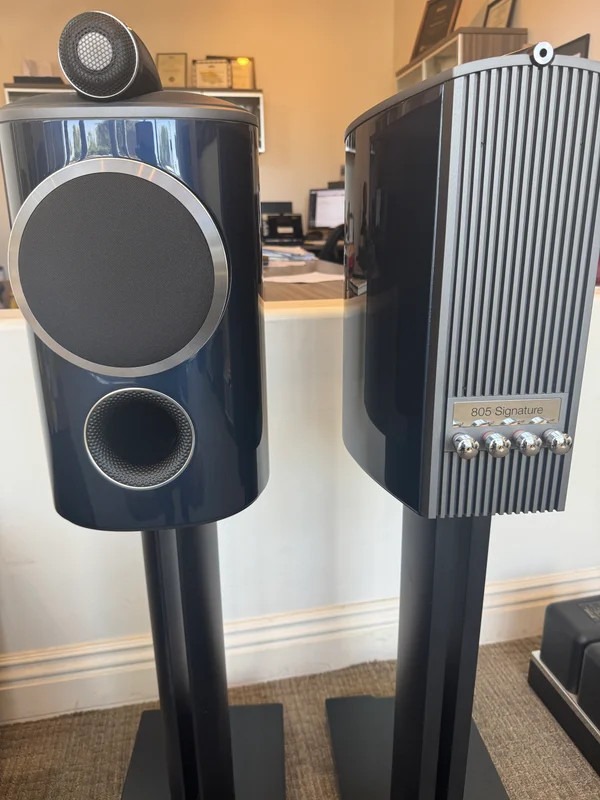
B&W periodically releases Signature editions with upgraded componentry and finishes as a nod to the brand’s history — the practice traces back to a 1991 Silver Signature released posthumously in John Bowers’ honor. The current 801 D4 Signature and 805 D4 Signature launched in mid-2023 with Midnight Blue Metallic and California Burl Gloss finishes, an optimized aluminum top section, an upgraded crossover, and an elongated tweeter housing on the 801.
Nautilus (1993–present)
The Nautilus reference speaker, discussed above for its tail-loading technology, remains in production today as a hand-built-to-order flagship rather than a discontinued collector’s item — currently priced at $110,000 per pair, available in Black, Midnight Blue, or Silver with custom color-match options.
CM Series and PM1
The CM Series and the PM1 standmount are older, now-discontinued B&W ranges that still surface on the used market. We were not able to independently confirm their exact discontinuation dates from primary sources for this guide — if you’re evaluating a used pair, confirm current parts and service status directly with B&W or an authorized dealer rather than assuming continuity with the current lineup.
Current Product Line
All prices below are B&W’s own published US pricing as of this writing. D4 is the shipping 800 Series generation today, but with D5 announced for a September 9, 2026 on-sale date, expect D4 pricing — new and used — to move over the following months.
B&W also sells the Formation wireless multi-room line and a headphone range, but this guide focuses on the high-end passive loudspeakers that dominate B&W’s used market.
Warranty, Certified Pre-Owned Status, and Factory Service
This is the section a used-B&W buyer should read most carefully, because the honest answer diverges from how some other high-end speaker brands operate.
Warranty length and transferability
B&W’s standard passive loudspeaker warranty runs 5 years. It is explicitly not transferable — B&W’s own warranty terms state the coverage “is only valid for the original owner” and that “this limited warranty is not transferable.” A used pair bought from a second owner carries no factory warranty at all, regardless of the original speaker’s age.
B&W references its Encompass parts platform for drivers, diaphragms, and accessories, including for older models. We were not able to independently verify the depth of parts availability for legacy Kevlar-era 800 Series drivers specifically — before buying a pair likely to need service, confirm parts availability directly with B&W or an authorized dealer rather than assuming full support the way you might with a brand that publishes an explicit lifetime-parts commitment.
What to Look for When Buying Used
With no factory certification program standing behind a used purchase, inspection quality and seller history matter more with B&W than with brands that recertify pairs before resale.
Identify the generation by the drivers
The midrange cone tells you the generation fastest. A yellow cone means Kevlar — pre-2015, D2 or earlier. A dark composite cone means Continuum — D3 (2015) or newer. Combined with the cabinet shape (curved front on D3/D4, curved rear on earlier generations) and the presence or absence of a cast-aluminum Turbine head, you can place a pair’s generation before even checking a serial number.
Driver condition
Kevlar cones on pre-2015 pairs are generally durable but should be inspected for creasing, discoloration, or prior repair work. Continuum and Aerofoil cones (D3 and newer) should be checked for any sign of sagging or settling at the surround. The Diamond dome tweeter is the single most expensive component to replace if damaged — inspect closely for dents or discoloration, and ask directly whether it has ever been replaced and with what part.
Cabinet finish
B&W’s piano gloss finishes show chips and scuffs at cabinet corners more readily than satin finishes. On rosenut or cherry veneer pairs, check for UV fading or veneer lifting at the seams. Any refinishing work should be disclosed by the seller — ask who performed it.
Turbine head and cabinet hardware
On D3/D4-generation pairs, inspect the cast-aluminum Turbine head for dents or impact damage — it is a structural component, not just cosmetic. Confirm the original binding posts and any biwiring hardware are present and undamaged.
Packaging and shipping risk
800 Series pairs ship in substantial dedicated packaging; buying a pair without its original crating adds real shipping risk and cost if the speakers ever need to move again. Factor this into your offer if original packaging is missing.
Serial numbers and provenance
Ask for photos of the serial plates and, where possible, any original purchase documentation. Because there is no factory certification program to lean on, a documented ownership and service history is doing more of the trust-building work than it would with a certified-pre-owned purchase.
B&W on the Used Market
Hard depreciation data for B&W’s used market is thinner than for some competing brands — B&W does not run a certification program that would generate the kind of dealer trade-in data other brands publish or that shows up consistently in resale listings. What follows is a qualitative picture rather than a precise percentage-based model.
Anecdotally, a used 800 D3 pair (originally in the roughly $30,000-per-pair tier) has been observed listed around $19,500 on the secondary market — consistent with meaningful but not extreme depreciation for a well-regarded outgoing-generation flagship. Treat that as illustrative of the general pattern rather than a reliable pricing benchmark; we did not find a rigorous generation-over-generation depreciation study to cite with confidence.
Two structural factors are worth watching. First, the D4 generation dropped the standalone “800” model name — D3 was the last generation sold as “800 D3,” which may support elevated collector interest in D3 pairs specifically, though that is a reasonable inference rather than confirmed market data. Second, with 800 Series D5 announced for a September 2026 on-sale date at meaningfully higher pricing than D4, expect D4 secondary-market values to soften over the following year as the new generation arrives and D4 becomes the outgoing model — the same generational-compression pattern that plays out across high-end audio whenever a flagship line steps to a new letter or number.
Room and System Matching
B&W’s flagship speakers are rated at a nominal 8 ohms, but — like most serious loudspeakers — the measured impedance tells a more demanding story than the nominal number.
Impedance and sensitivity
Stereophile’s measurements of the 804 D4 found a sensitivity close to B&W’s own 89dB/2.83V/m specification, with nominal 8-ohm impedance dipping to roughly 3 ohms at points in the audio band. The flagship 801 D4 Signature measured similarly at the top — B&W specifies 90dB sensitivity, with John Atkinson’s measured impedance falling to about 3.2 ohms at 90Hz and an effective peak dissipation resistance below 2 ohms across stretches of the bass and midrange, prompting Atkinson to call it one of the most current-hungry loads he has measured. In practice, this means an amplifier rated for high wattage into 8 ohms alone is not sufficient — genuine current delivery into low impedance matters more than the headline power figure.
Amplifier partnerships
Classé — a fellow Sound United/HARMAN sibling brand, confirmed still part of the same portfolio as of the September 2025 HARMAN acquisition close — is a natural, in-family amplifier pairing for B&W speakers. Beyond that in-house option, B&W’s flagship models appear regularly paired with high-current solid-state amplification from brands like McIntosh, Krell, Mark Levinson, Pass Labs, and Dan D’Agostino in dealer demonstrations and reviewer systems — there is no single official B&W amplifier partner, but the pattern across demonstrations favors current-capable solid-state designs over lower-power tube amplification for the 800 Series specifically.
Room size
As with most flagship-tier loudspeakers, larger 800 Series models (801, 802) want proportionally larger rooms to develop their bass output without overwhelming the space; the 805 and 700/600 Series models scale down accordingly. B&W does not publish specific square-footage guidance, so use cabinet size and rated bass extension as a practical proxy — a 15Hz-capable 801 in a small room will be working against the room, not with it.
Frequently Asked Questions
Who owns Bowers & Wilkins today?
As of September 23, 2025, Bowers & Wilkins is owned by HARMAN International Industries, a wholly-owned subsidiary of Samsung Electronics Co., Ltd. B&W operates within Sound United, which HARMAN confirmed runs as a standalone Strategic Business Unit inside HARMAN’s Lifestyle Division. It is the fourth ownership change since 2016, following EVA Automation, Sound United (as an independent company), and Masimo Corporation.
Are B&W speakers still made in Worthing?
Yes — the 800 Series and the Nautilus are still hand-built at B&W’s Dale Road factory in Worthing, England. Most of the rest of the current lineup is manufactured in China, per trade-press factory reporting. The 800 Series has been built in Worthing since the company relocated production there in 2002.
What’s the current 800 Series generation?
800 Series Diamond D4 is the generation currently shipping, but B&W announced the D5 generation on June 4, 2026, with sales beginning September 9, 2026. D4 launched September 1, 2021. D5 brings Space Frame Bracing, an enhanced Matrix internal structure, Signature-spec crossover components across the whole range, and a tuned-mass-damping plinth. Buyers shopping now should factor the imminent D5 launch into any D4 purchase, new or used.
What’s the difference between 800 D3 and 800 D4?
D3 (2015) introduced the Continuum midrange cone, Aerofoil bass cones, the cast-aluminum Turbine head, and the Reverse Wrap cabinet — replacing the prior generation’s yellow Kevlar midrange and rear-curved cabinet shape. D4 (2021) kept all of those D3-era technologies and added a Biomimetic Suspension in the midrange driver (replacing the traditional fabric spider) and a cast-aluminum top plate in place of the earlier wood top section.
Is there a Certified Pre-Owned program for used B&W speakers?
No. Unlike some high-end speaker brands, B&W does not offer a factory certification program for privately-owned used pairs. B&W’s "Recertified" storefront sells the company’s own returned or refurbished inventory directly, with a 2-year warranty on those specific units — it is not a service you can send a customer-owned pair through. This is a genuine difference from brands that do offer certified pre-owned programs, and it is worth knowing before you buy.
Are B&W speakers still used at Abbey Road Studios?
Yes. Abbey Road adopted the original 801 as a reference monitor in 1980, and B&W states the latest 800 Series Diamond speakers are in use there today. The relationship is the longest-running speaker partnership at Abbey Road and is part of why the 800 Series is positioned as B&W’s reference line rather than just its flagship.
What is the Nautilus, and can I still buy one?
The Nautilus is B&W’s 1993 flagship reference loudspeaker, distinguished by its tapered, snail-shell tail-loading tubes that absorb each driver’s rear energy instead of reflecting it back through the cone. It remains in production today, hand-built to order, at $110,000 per pair. It is not a discontinued collector’s piece — it is still B&W’s current statement product, more than three decades after its debut.
What’s the difference between the yellow Kevlar and Continuum midrange drivers?
Kevlar was B&W’s midrange cone material from the 1970s through the D2 generation, valued for its stiffness-to-weight ratio; Continuum, introduced in the 800 D3 (2015), is a composite cone material developed to avoid the abrupt behavioral transitions a conventional cone exhibits as it flexes. Continuum was an eight-year development project and has since filtered down from the 800 Series into the 700 and 600 Series. A used pair with the yellow Kevlar cone is pre-2015; Continuum signals D3 or newer.
Are 800 Series speakers hard to drive?
Yes, more than their published 8-ohm nominal rating suggests — measured impedance on flagship 800 Series models dips well below that in the bass and lower midrange. Stereophile’s measurements of the 801 D4 Signature found the impedance falling to roughly 3.2 ohms with an effective peak dissipation resistance below 2 ohms across parts of the bass and midrange — John Atkinson described it as one of the most current-hungry loads he has measured. Budget for a genuinely high-current amplifier, not just one rated for high wattage into 8 ohms.
What’s the best used B&W 800 Series generation to buy?
It depends on budget and priorities, but D3 (2015–2021) is worth close attention: it introduced the Continuum midrange and Aerofoil/Turbine/Reverse Wrap technologies that still define the current design language, and it was the last generation to carry the standalone "800" model name before D4 restructured the naming to start at 801. That naming change may itself be part of why D3 draws collector interest. Buyers should still weigh D3 against a D4 pair at a similar used price — D4 added the Biomimetic Suspension and aluminum top plate, and with D5 now announced, D4 pricing on both the new and used markets should be expected to soften over the next year.
Are B&W speakers a good value used?
For buyers comfortable without a factory certification program, yes — the core 800 Series engineering (Matrix bracing, tail-loading, Diamond tweeter) has a long track record, and Worthing-built 800 Series pairs are durable, serviceable speakers. The absence of a CPO program means condition and provenance matter more on a private-party purchase than they would with a brand that recertifies used pairs — inspect drivers and cabinets carefully, and buy from a source that can speak to the speakers’ history.
Can I get replacement drivers for a 20-year-old 800 Series pair?
B&W references its Encompass parts platform for drivers, diaphragms, and accessories, including for legacy models. Availability for a specific 20-year-old part is worth confirming directly with B&W or an authorized dealer before buying a pair that will need service — parts support depth for older Kevlar-era drivers specifically was not something we could fully verify from published sources, so treat it as a question to ask, not an assumption to make.
Authorized Bowers & Wilkins Dealers
LMC Home Entertainment, HFR’s anchor dealer for several other brand chapters, does not carry Bowers & Wilkins. For current authorized dealers, B&W maintains a Find a Retailer locator; two regional US dealers verified directly for this guide:
Barrett’s Technology Solutions — Lombard & Chicago, IL
An authorized B&W retailer with a showroom in Lombard, IL and a by-appointment location in Chicago. Confirm current inventory and authorization status directly, as dealer rosters change.
No authorized B&W dealers are listed on HFR yet. Check back as HFR’s dealer network grows.
Asking price compared against 11 market transactions averaging $8,947, ranging from $3,490 to $14,000. Compiled from completed sales across the used market, not HiFi Registry transactions.
A curated bibliography of the sources cited throughout this Buyer’s Guide chapter. All specialist reviews and manufacturer materials referenced in the sections above are indexed here.
 Authorized dealer