Asking price compared against 13 market transactions averaging $19,692, ranging from $8,750 to $27,500. Compiled from completed sales across the used market, not HiFi Registry transactions.
Audio Research
A chapter of HFR’s Complete Buyer’s Guide to High-End Audio
The company that reintroduced the vacuum tube to high-end audio. Fifty-five years of hand-built preamplifiers and power amplifiers, made in Minnesota, and — despite five ownership changes since founder William Z. Johnson sold in 2008, including a 2023 receivership — supported by a factory that has never left the state.
This guide covers Audio Research’s full history including its ownership changes through 2026, the SP-series and Reference-series model lineages, current products, and what to know before buying used ARC gear.
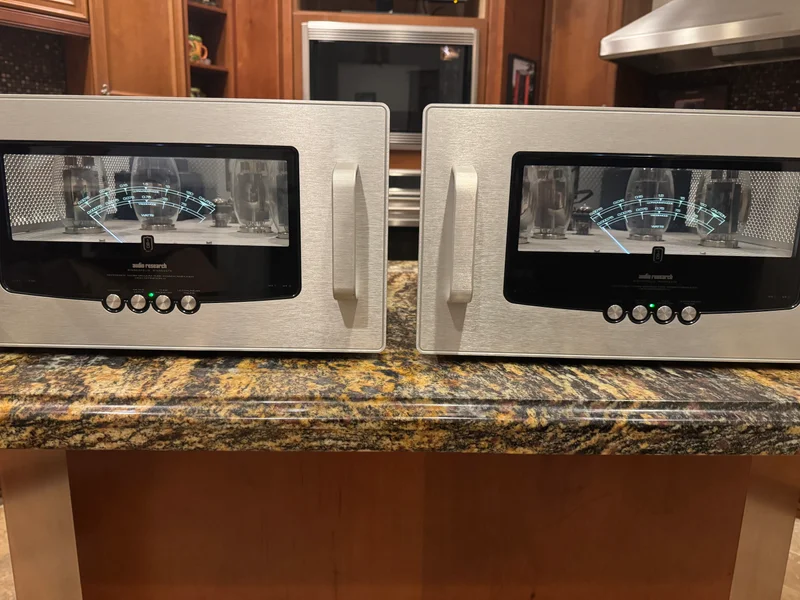
1 active Audio Research listing on HFR.
Company history
William Z. Johnson and the founding
Audio Research’s origin is inseparable from William Zane Johnson personally. Johnson founded the company in 1970 in Minneapolis, having begun designing custom audio electronics in the early 1950s and operated a specialty audio retail store, Electronic Industries, in Minneapolis until the mid-1960s. Johnson was chief engineer and founder, and industry observers widely credit him as one of the people who defined what high-end audio means as a category.
Johnson was on record for a specific, contrarian technical position. In an interview published in Stereophile’s August 1994 issue, Johnson stated: “I tried transistors, but I thought the sound that I was able to generate with various design approaches was horrendous — it was terrible.” He explained that when FETs arrived he tried again — the designs measured well but still didn’t sound right to him — and concluded that an all-out design effort with vacuum tubes could still win. The Absolute Sound’s Jonathan Valin summarized Johnson’s stature at his death: “Where would the high end be without William Zane Johnson? As with so many of my generation, he and his creations are the high end to me — and always will be.”
Ownership timeline
1970–2008 — Founder ownership. William Z. Johnson owned Audio Research privately for 38 years.
January 2008 — Quadrivio. Johnson, then 82, sold Audio Research to Quadrivio SGR, a Milan-based Italian private-equity firm that had acquired Sonus Faber the year before, forming what became Fine Sounds Group. Johnson stayed on as honorary chairman, stepping back from day-to-day operations. Fine Sounds Group’s subsequent “buy and build” strategy went on to acquire Sumiko (2010), Wadia (2011), and McIntosh Laboratory (2012).
2014 — Management buyout. Fine Sounds Group was purchased from Quadrivio by a group headed by Charles Randall and Mauro Grange.
2016 — Rename to McIntosh Group. Fine Sounds Group was renamed McIntosh Group, emphasizing the primacy of the McIntosh brand within the portfolio.
August 2020 — TWS Enterprises. McIntosh Group sold Audio Research to TWS Enterprises, the privately held company of Trent Suggs, ARC’s former Director of North American Sales. Suggs said at the time: “I’ve got no bank note, no debt, no partners. My heart has always been at ARC.” The deal reunited longtime ARC people — Suggs as president, Brandon Lauer as director of marketing and international sales, and Dave Gordon returning as managing director after three decades with the company.
2023 — Assignment for the Benefit of Creditors. TWS Enterprises entered a Minnesota-law Assignment for the Benefit of Creditors — a form of receivership distinct from Chapter 7 or Chapter 11 bankruptcy, in which a debtor’s assets are transferred to a trust controlled by an assignee. Patrick Finn of Lighthouse Management Group served as assignee.
June 2023 — AR Tube Audio Corporation. A court approved the sale of Audio Research’s assets to Valerio Cora of Toronto-based Acora Acoustics, on a winning bid of $1,088,888.18. The company was re-formed as AR Tube Audio Corporation, with Cora as director. Operations stayed in Maple Grove, and all Audio Research warranties — past, present, and future — were confirmed to remain in force.
July 2, 2026 — Leadership transition. Acora Acoustics and Audio Research announced that Valerio Cora was transitioning out of day-to-day executive responsibilities at both companies, remaining a minority investor. Crystal Claire — identified as the companies’ principal financial backer — began providing direct oversight during a strategic and operational review, with Toronto-based Principal Investor Roger Hwang leading that process. Roger Hwang said: “Our focus now is to bring clarity, discipline, and stability to the business while supporting the dealers and customers who believe in the brand.” David Gordon returned to his former role as Brand Ambassador, effective July 2026, described by the company as a step toward continuity rather than reinvention.
Practical implications for used-market buyers
Manufacturing has stayed in the Minneapolis–St. Paul metro area continuously since 1970 through every ownership change — moving from Minneapolis to nearby Plymouth, and then to Maple Grove in August 2018. The 2023 receivership and the 2026 leadership transition were both explicitly framed around warranty and service continuity rather than disruption, and the current AR Tube Audio Corporation entity has operated under that name continuously since 2023.
Design philosophy
Johnson’s original position was empirical, not dogmatic: tubes sounded better than transistors on the terms he chose to test on, so he used tubes, and where solid-state genuinely improved a specific stage without corrupting the design intent, ARC used it. What has stayed consistent across five and a half decades is a set of engineering priorities rather than a fixed circuit topology.
Balanced circuit topology
ARC preamps and amplifiers are designed as balanced circuits. Single-ended RCA inputs are accommodated but converted internally.
Partial cathode coupling on power amplifiers
ARC’s power amplifiers use ultralinear output transformers with partial cathode coupling to the output terminals — a design the company has used since at least the VT100 and VT200 of the 1990s to achieve higher efficiency and lower output impedance than conventional tube designs, improving drive into a wider range of speaker loads.
Reference-tier engineering migrates downward
ARC’s current amplifier line is a direct descendant of a two-decade lineage: the Reference 110 was reviewed in Stereophile in 2007 and was later replaced by the Reference 150; the Reference 210 and 610 line evolved into the Reference 250 and Reference 750, described by the company as “the culmination of 50 years of continuous research and development in the art of vacuum tube amplification”. New engineering proven at the top of the range — most recently in the Reference 330M monoblock — has historically migrated into lower tiers over subsequent product cycles.
Every I-series unit individually voiced
ARC’s current integrated amplifiers are fine-tuned by staff sonic designer Warren Gehl before shipping — a hands-on quality step the company has continued from the original I/50 through the current I/70.
Iconic model families
The SP series preamplifiers (1972–1980s)
The SP-3, introduced in 1972 at $595, is regarded as one of the most important preamplifiers in the history of high-end audio — Stereophile described it as “a straight wire with gain,” a benchmark phrase that stuck to the ARC preamp lineage for decades, while The Absolute Sound called it “the best sounding preamplifier available in America today.” The SP-6 followed in 1978. The SP-10, introduced in 1982 at $3,700, added a two-chassis topology with a separate outboard power supply and became the reference tube preamp of its decade. The SP-11 followed in October 1985 at $4,900 as ARC’s first hybrid design, combining tube and solid-state circuitry, and reviewers of the time judged it noticeably better than the SP-10 in direct comparison.
The VT-series power amplifiers (1990s–2000s)
The VT100, rated at 100 watts per channel using matched pairs of 6550 output tubes, and the higher-power VT200 established the partial-cathode-coupling ultralinear output stage that ARC power amps still use in principle today.
The Reference series (1998–present)
Introduced in 1998 at $8,495 and reviewed by Wes Phillips in that November’s Stereophile, the Reference 1 was Johnson’s own top-of-the-line design, developed with the SP-10 as its conceptual starting point. It became ARC’s flagship preamp lineage and was followed in turn by the References 2, 3, and 5, each setting a new performance standard within the line. On the amplifier side, the Reference 110 and its descendants evolved into the current Reference 330M and 750 SEL monoblocks. In 2026 the line was refreshed again with the REF20 and REF7 preamplifiers, which premiered at AXPONA 2026.
Integrateds — I/50 and I/70
The I/50, the first product in an all-new integrated series, is a 50-watt-per-channel design available in six Cerakote finishes with optional modular phono and DAC boards, fine-tuned by staff sonic designer Warren Gehl. The I/70, its larger sibling, incorporates the output transformer from the Reference 75 amplifier and adds an active tube preamp section, an improved phono stage, and a tube headphone output, at an MSRP of $9,950.
Current product line (2026)
Audio Research’s own current-lineup materials highlight three anchor products: the I/70 integrated amplifier at the accessible end, the REF20 preamplifier, and the 330M monoblock power amplifier, which the company calls its most accomplished amplifier to date.
Reference tier
The Reference 330M monoblock, introduced in 2024, and the REF20 and REF7 preamplifiers, which premiered at AXPONA 2026 ($28,000 for the REF7), represent the current top of the line. Audio Research describes the REF20 as building on the engineering the company developed for the 330M, and as both a successor to the earlier Reference 10 and a matched partner for the 330M.
I-series integrateds
The I/70 ($9,950 standard) and the earlier I/50 remain in the line as ARC’s single-chassis entry point, aimed at buyers who want the ARC sound without a separates system.
Service and support
Audio Research operates its service and manufacturing facility at its Maple Grove, Minnesota headquarters, and the company states it will repair and restore most products across its 55-year history, including decades-old units. Warranty terms are published on audioresearch.com; confirm current coverage and any transfer requirements directly with the factory or an authorized dealer using your unit’s serial number, particularly given the ownership changes documented above.
Because ARC has been in continuous production since 1970, a substantial population of independent and factory-trained technicians exists in the Minneapolis–St. Paul area and nationally with documented experience on ARC gear. For anything still under the AR Tube Audio Corporation warranty, factory service is the safer first call.
Buying used Audio Research
Audio Research is one of the deepest and most continuously-produced used markets in high-end audio — the company has never had a true production gap since 1970, even through five ownership changes and a 2023 receivership. That depth is an advantage: a wide range of ARC gear, from SP-series classics to recent Reference-tier separates, circulates on the secondary market at any given time.
Match the era to the use case
Johnson-era gear (pre-2008) carries genuine collector interest, particularly the SP-3, SP-10, and SP-11. For a modern, fully balanced system, current or recent Reference-tier separates are the more coherent match; the underlying engineering priorities — balanced topology, partial cathode coupling on power amps — have stayed consistent, but the noise floor and control electronics on current products are meaningfully more advanced.
Verify ownership-era service history
Given the company’s ownership history, it’s reasonable to ask a seller when a unit last had factory service and under which corporate era that service happened. All eras have explicitly maintained warranty continuity and Maple Grove manufacturing, so this is a service-history question, not a red flag by itself.
Consider the classics as first purchases
The SP-10 and SP-11 remain the two most consistently cited classic ARC preamps in used-market retrospectives, and both are readily serviceable through the factory today.
Sold-price data and market observations
Used ARC pricing has been shaped more by the company’s ownership history than by typical generational depreciation curves. The 2023 receivership prompted public concern about the company’s future, and the 2026 leadership transition drew renewed industry coverage, but in both cases the company moved quickly to confirm warranty and manufacturing continuity — the message investors and audio press consistently emphasized was stability, not disruption.
Johnson-era SP-series classics (SP-3, SP-6, SP-10, SP-11) hold collector interest independent of the company’s ownership news. Current-generation Reference-tier gear tracks a more typical high-end depreciation pattern: a meaningful first-owner discount, then a slower decline for well-serviced units.
Frequently Asked Questions
Is Audio Research still in business? Was it bankrupt?
Yes, operating normally as of mid-2026 at its Maple Grove, Minnesota facility. In 2023 the company’s then-owner, TWS Enterprises, entered a Minnesota-law Assignment for the Benefit of Creditors — a form of receivership, not the same as Chapter 7 or Chapter 11 bankruptcy. Audio Research’s assets were then acquired at auction by Valerio Cora of Acora Acoustics for a winning bid of $1,088,888.18, and the company was re-formed as AR Tube Audio Corporation. Manufacturing stayed in Maple Grove throughout, and all Audio Research warranties — past, present, and future — were confirmed to remain in force.
Who owns Audio Research now?
As of July 2026, Audio Research is owned by AR Tube Audio Corporation. Crystal Claire is the company’s principal financial backer and majority owner, with Toronto-based Principal Investor Roger Hwang overseeing a strategic and operational review announced July 2, 2026. Valerio Cora, the 2023 buyer, stepped down from day-to-day executive responsibilities in that announcement and remains a minority investor.
Are ARC warranties still valid after the ownership changes?
Yes. The 2023 sale to AR Tube Audio Corporation explicitly confirmed that all Audio Research warranties — past, present, and future — remain in force, and the 2026 leadership change did not alter that. Contact Audio Research with your unit’s serial number to confirm coverage on a specific piece.
Where are Audio Research components manufactured?
Maple Grove, Minnesota. The company moved there from nearby Plymouth, Minnesota in August 2018, having originally been founded in Minneapolis in 1970. Manufacturing has stayed in the Minneapolis–St. Paul metro area throughout.
Should I buy a used SP-10 or a current Reference preamp?
Different products for different systems. The SP-10 (1982, $3,700 at introduction) is a classic two-chassis tube preamp that remains musical decades later but has no auto-bias or modern noise-floor engineering. A current Reference-tier preamp is a fully modern balanced design. If your system is fully balanced and current-generation, stay in the Reference line; for the specific character and historical significance of a classic ARC preamp, the SP-10 is a genuine reference point.
Authorized Audio Research dealers on HFR
Only authorized Audio Research dealers can sell new ARC product or provide factory-warranty-eligible service.
No authorized Audio Research dealers are listed on HFR yet. Check back as HFR’s dealer network grows.
For the current authorized dealer network directly from the manufacturer, see audioresearch.com.
Audio Research Listings on HFR
Sources & Further Reading
A curated bibliography of the sources cited throughout this Buyer’s Guide chapter. All specialist reviews and manufacturer materials referenced in the sections above are indexed here.
Manufacturer
Specialist reviews and features
- Stereophile — William Z. Johnson of Audio Research: High Definition (Aug 1994 interview)
- The Absolute Sound (reprint) — Jonathan Valin, William Zane Johnson editorial, Issue 220
- Stereophile — William Zane Johnson, 1926–2011
- Stereophile — Audio Research SP-3 preamplifier
- Hi-Fi Hall of Fame — Audio Research SP-3
- Stereophile — Audio Research SP-10 preamplifier specifications
- tonepublications — Audio Research SP-11 preamplifier
- audio-database.com — Audio Research Reference 1 specifications
- Stereophile — Audio Research VT100 power amplifier
- Stereophile — Audio Research Reference 110 power amplifier
- Stereophile — Audio Research Reference 150 power amplifier
- listenroom.com — Audio Research Reference 750SEL Monoblock Power Amplifier
- Tracking Angle — World Premiere Review of Audio Research’s Ref 20 Preamplifier
- ecoustics — Audio Research I/50 Integrated Amplifier Delivers Colorful Change
- overtureav — Audio Research I/50 Integrated Amplifier
News and industry announcements
- Strata-gee — Audio Research Corp Begins Its Next Chapter as AR Tube Audio Corporation
- ecoustics — Audio Research Has a New Lease on Life (2023 acquisition detail)
- Strata-gee — New Changes Hit Audio Research & Acora Acoustics; CEO Cora Is Out of Both
- Positive Feedback — Acora Acoustics Announces Leadership
- HiFi Blog — Audio Research Corp Brings David Gordon Back
← Back to the Buyer’s Guide · Audio Research’s official site ↗
